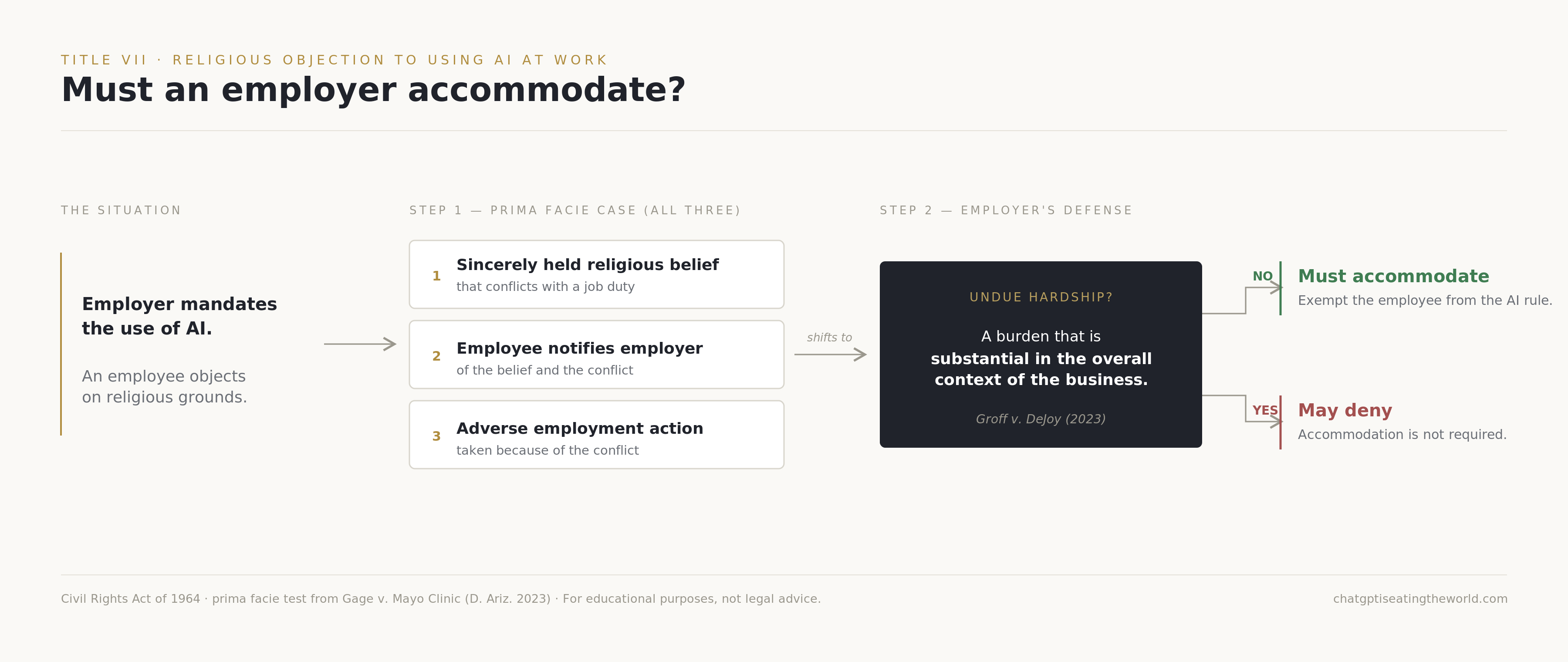
- Employers mandating that employees must use AI for work will likely face opposition from some employees.
- Under Title VII, employees who have sincerely held religious beliefs against using AI may request the employers grant them a reasonable accommodation not to use AI.
- Employers will likely have to grant such a request unless they can prove it would cause an undue hardship to the employers evidenced by “substantial increased costs.”
Pope Leo XIV’s lengthy encyclical on AI sparked a larger public debate on AI regulation. But it also raised a fundamental question about what role religion and religious views should play in this debate — and in the use of AI generally.
We are beginning to see employees invoking religious objection to the use of AI to be exempt from an employer’s directive for employees to use AI at work.
Software engineer Erin Maus reportedly received from her employer an “accommodation … and … permission … to avoid using workplace AI on religious grounds.” She is a Unitarian Universalist, according to the article. Maus requested not to use AI in her computer programming at work. Her employer granted her request as a religious accommodation.
We should expect other employees will be asking their employees for religious-based accommodations to exempt them from any work requirement to use AI.
Title VII of the Civil Rights Act of 1964
Under federal law, employers cannot discriminate against their employees “with respect to his compensation, terms, conditions, or privileges [of] employment, because of such individual’s … religion.”
When does a religious belief of an employee warrant a reasonable accommodation?
The courts have required the following elements for an employee to establish a prima facie claim of religious discrimination under Title VII:
(1) she had a [*sincerely held] religious belief, the practice of which conflicts with an employment duty;
(2) she informed her employer of the belief and conflict; and
(3) the employer discharged, threatened, or otherwise subjected [her] to an adverse employment action because of her inability to fulfill the job requirement.
Gage v. Mayo Clinic, 707 F. Supp. 3d 370 (D. Ariz. 2023) (quoting Peterson v. Hewlett-Packard Co., 358 F.3d 599, 606 (9th Cir. 2004) (cleaned up). *Note: I have substituted “sincerely held” for “bona fide” in the Gage opinion because “sincerely held” is the more specific language the EEOC and other court decisions use for bona fide. See EEOC v. GEO Group, Inc., 616 F.3d 265, 271 (3d CIr. 2010).
We created a chart to see the elements of a religious accommodation claim in the AI context:

What is undue burden on the employer to Justify denying accommodations?
If the employee establishes elements (1) and (2) of a prima facie claim above, the employer must grant the employee a reasonable accommodation of “the religious practice of their employees unless doing so would impose an undue hardship on the conduct of the employer’s business.’” Groff v. DeJoy, 600 U.S. 447, 453 (2023).
In Groff, the Supreme Court clarified that undue hardship goes beyond a showing of “more than a de minimis cost” as had been suggested in a past decision TWA v. Hardison. Undue burden requires a showing that “a burden is substantial in the overall context of an employer’s business.” Id. at 468. It is a burden shown by “substantial increased costs in relation to the conduct of [the employer’s] particular business.”
The effect of Groff is that it will be harder for employers to prove an undue burden. It must be substantial and it must involve substantial increased costs caused by the religious accommodation.
A prior successful lawsuit, US EEOC v. Consol. Energy Inc., involving the denial of religious accommodation of Beverly Butcher Jr. to be exempt from the mining company’s use of biometric scanners (to track attendance) filed by the EEOC provides a somewhat analogous situation. “[T]he federal court issued an order awarding a total of $586,860 in lost wages and benefits and compensatory damages, and permanently enjoining the companies from committing similar acts in the future in violation of Title VII.”
*Information in article provided for educational and news purposes only. It does not constitute legal advice.
DOWNLOAD THE 4TH CIRCUIT’S DECISION IN US EEOC V. CONSOL. ENERGY, INC.
