Late Thursday night, Judge Alsup issued his third order on the Bartz class notice. The order is the most scathing critique of the Bartz class’s process for class members.
Judge Alsup found that (1) the class website lacks a button for class members to opt out while presenting a button to file a claim for settlement money and (2) “the entire process engineered by class counsel is steered toward submitting claims and steered away from opting out.”
Judge Alsup’s Prior 2 Orders
Prior 2 Orders of Judge Alsup: In the prior 2 orders, Judge Alsup expressed serious concerns with (1) how 18,000 class members already filed claims for money from the settlement before official class notice has been directly sent to each class member (because it’s still being approved) (2) without adequate information advising them of their right to opt out of the settlement completely (and pursue their own claims). [*The class website had stuck the opt out process in FAQ 40 and required class members to submit their opt out by email or direct mail.]
Judge Alsup was so concerned about what he called the lack of “equal dignity” being given to the right to opt out (versus the right to file a claim), he issued a broad preservation order requiring Class Counsel and basically everyone associated with Class Counsel in the class settlement to preserve all their communications, however informal, to class members. (Unclear at the moment whether Judge Alsup will review those communications later.)
Judge Alsup’s Third Order
Judge Alsup’s Third Order last night expressed even greater concerns about the entire class process. The Judge found the entire process was slanted: “But the most important among them is that the entire process engineered by class counsel is steered toward submitting claims and steered away from opting out.”
Judge Alsup ordered the following for Class Counsel to implement “IMMEDIATELY”:
- Complete disabling of current Class Website: “IMMEDIATELY, class counsel shall disable the claim form and remove all text and functionality from the website except for a faithful reproduction of the approved buckslip with approved long-form class notice, and/or the list of and links to the key documents in the case.”
- Website Must Give “Equal Dignity” to Opt Out, including an Opt Out Button and Form: “The options to file a claim and to opt out must be equal in dignity. The following are specifically ordered requirements and also examples of the principle to heed: If there is a button to file a claim, there must be a nearby button to opt out. If there is an electronic form to file a claim, there must be an electronic form to opt out (which was promised but not delivered). If there is an electronic form to file a claim that comes prepopulated and perfectly crafted to be easy and compliant with all requirements, then there must be an electronic form to opt out that comes prepopulated and perfectly crafted to be easy and compliant with all requirements.”
- Website Must Present All 4 Options (File a claim, Opt out, Object, Do nothing) before offering class member any button to elect an option: “All four options — file a claim, opt out, object, do nothing — as well as their implications for class members’ rights must be presented before any button (or link) is presented to take anyone to any of these options. Before presenting buttons (or links), they must be advised that there is a complete, Court-approved notice about the preliminarily approved settlement that the Court advises class members to read before deciding how to act.”
- Electronic Form to File or Opt Out Should Direct to Class Notice and 4 Options: “Related to the last point, the electronic claim form and the electronic opt out form must have on any such form’s first page the statement that class members should first read the district court’s class notice discussing the settlement and class members’ four options under it with a link (or button) thereto to learn more.”
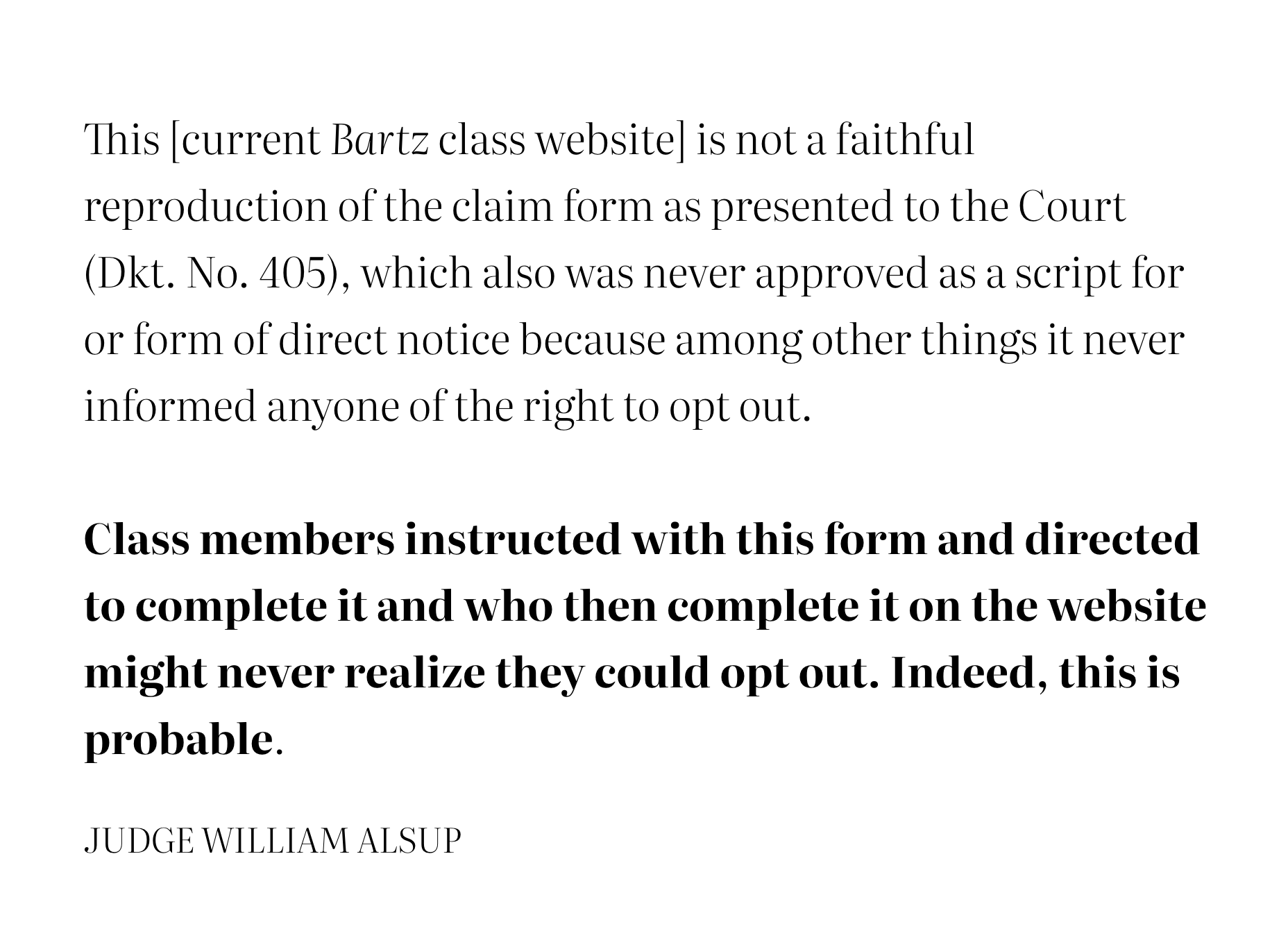
This [current Bartz class website] is not a faithful reproduction of the claim form as presented to the Court (Dkt. No. 405), which also was never approved as a script for or form of direct notice because among other things it never informed anyone of the right to opt out.
Judge William alsup
Class members instructed with this form and directed to complete it and who then complete it on the website might never realize they could opt out. Indeed, this is probable.
Deadline for revised website: “BY 7:30 A.M. ON NOVEMBER 25, 2025, all above-ordered changes shall be completed so that the settlement website and all forms are live in full compliance with this order.”
Excerpts from Judge Alsup’s Third Order


Judge Alsup approved the Class long form notice with his list of changes. But he also ruled that the short-form direct notice and other direct notice should not be used at all. “There is no need for it.” And it would only introduce more chances “for mistakes and confusion.”
By separate order, Judge Alsup largely denied the parties’ motion for more time to send the class notice. Judge Alsup pointedly ruled: “The Court does not need to nor want to see the notice again. The Court’s order was clear. Class counsel shall comply and make the required changes and this time send it to the class, not resubmit it to the Court (Dkt. No. 490 at 7).”
My Take
Judge Alsup is 100% correct.
If I can speak freely, I think it’s ridiculous the Class has to rely on Judge Alsup to figure out how to construct a reasonable design for the class website and notice that (i) informs all class members of their 4 options they can elect and (ii) pays “equal dignity” to each option for class members, including the ability to opt out with a click of a button (similar to filing a claim in the same manner).
This is not rocket science. This is not the first class action to distribute class funds. This is not the first class action website.
But if it’s the case that class actions generally lack best practices for how to administer class funds and opt outs, including the simple act of setting up a reasonable website to respect the rights of class members, that strikes me as a huge indictment of the cottage industry of class actions.
So, my concern may well be less with Class Counsel’s efforts–which, by all appearances, have been prodigious–and more with the entire cottage industry of class actions.
It’s well beyond time for best practices in class action websites, notices, and administration.
DOWNLOAD JUDGE ALSUP’S THIRD ORDER
DOWNLOAD JUDGE ALSUP’S ORDER ON EXTENSION OF NOTICE DEADLINE
Related Stories
