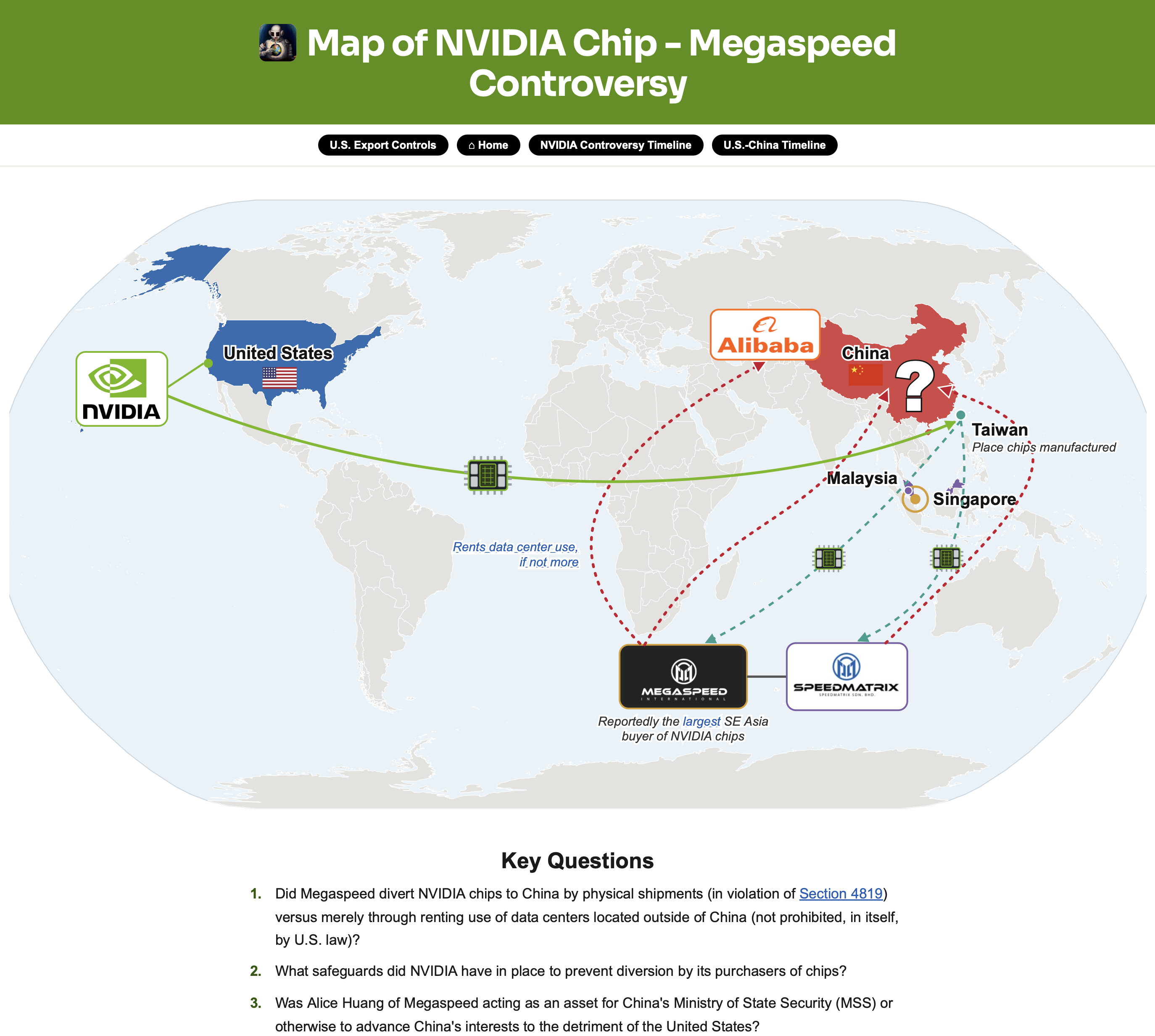
I’ve simplified the controversy involving NVIDIA, Jensen Huang, Alice Huang, and Megaspeed in one map. Click below to see the full map.

the key legal questions: were u.s. export controls violated?
At the center of the legal controversy is (1) whether Alice Huang/Megaspeed violated U.S. export controls barring shipments of advanced AI chips by NVIDA into China. For an overview of the complex U.S. export control law, click below. Physical shipments to China would violate U.S. law. But merely renting data center usage, powered by NVIDIA chips, to Chinese companies would not, in itself, violate U.S. law.
At least some reporting suggests that NVIDIA chips were — somehow — making their way into China.

If Alice Huang/Megaspeed was violating the U.S. export control, the next questions are: What did NVIDIA know? And what safeguards did NVIDIA have in place to prevent diversion by its purchasers of chips? As far as I can tell, we have very little public information relevant to answer these questions. Treasury Secretary Bessent has focused on these questions.
The third question is the one that has probably received the most media attention: Was Alice Huang of Megaspeed acting as an asset for China’s Ministry of State Security (MSS) or otherwise to advance China’s interests to the detriment of the United States? Often, this question is framed as, Was Alice Huang a “spy” for China? I think “spy” might conjure too much of an expectation of a James-Bond type of trained professional agent. “Asset” is better term. Someone who is used by intelligence agencies to gather access to and information from a targeted person, here, Jensen Huang.
DOWNLOAD THE MAP:
