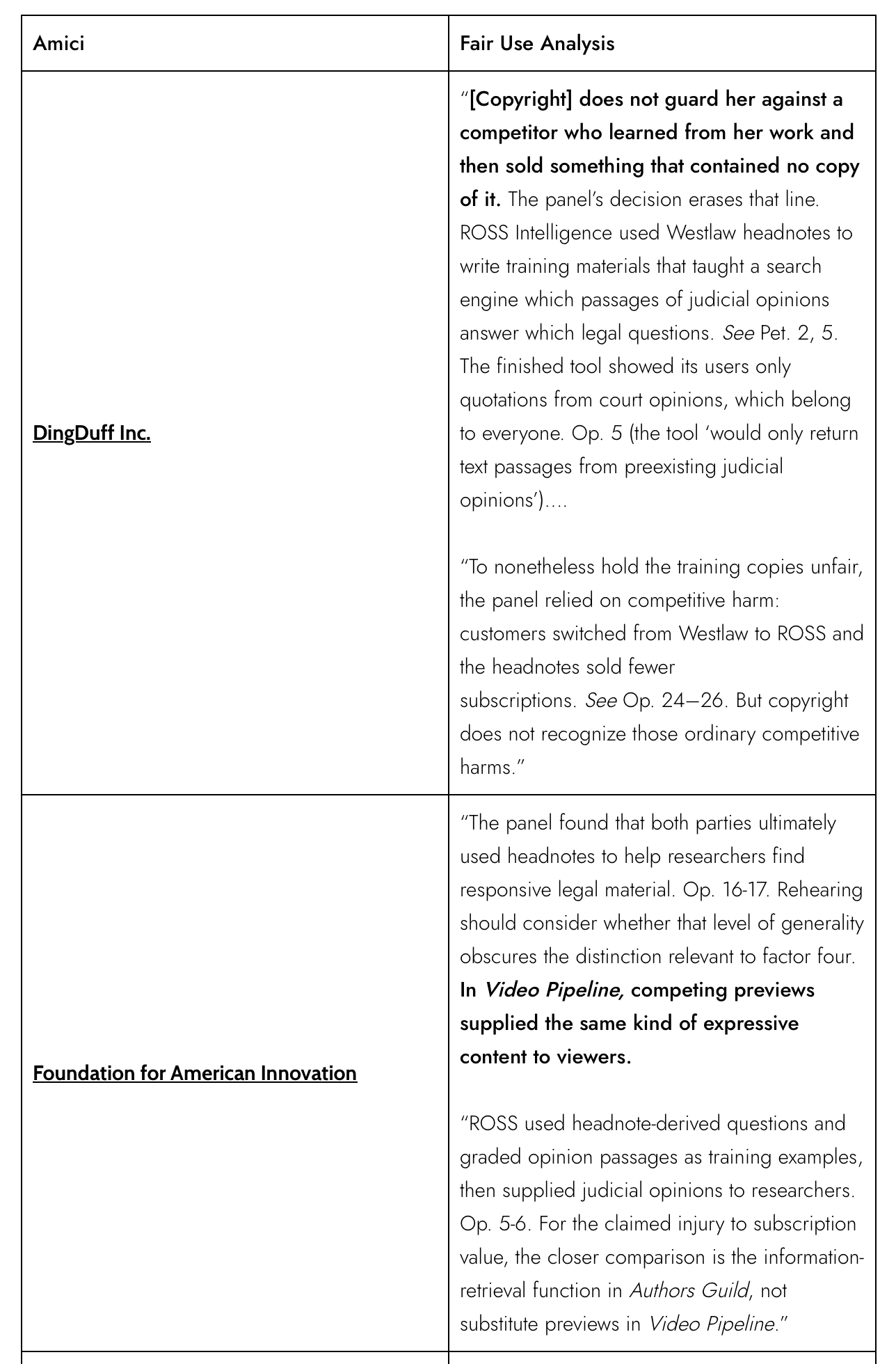
Numerous amici filed briefs in support of ROSS Intelligence’s bid for en banc review by the Third Circuit of the panel’s opinion affirming the grant of summary judgment in favor of Thomson Reuters’ copyright infringement claim.
Below are the amici briefs:
| Amici | Fair Use Analysis |
| DingDuff Inc. | “[Copyright] does not guard her against a competitor who learned from her work and then sold something that contained no copy of it. The panel’s decision erases that line. ROSS Intelligence used Westlaw headnotes to write training materials that taught a search engine which passages of judicial opinions answer which legal questions. See Pet. 2, 5. The finished tool showed its users only quotations from court opinions, which belong to everyone. Op. 5 (the tool ‘would only return text passages from preexisting judicial opinions’)…. “To nonetheless hold the training copies unfair, the panel relied on competitive harm: customers switched from Westlaw to ROSS and the headnotes sold fewer subscriptions. See Op. 24–26. But copyright does not recognize those ordinary competitive harms.” |
| Foundation for American Innovation | “The panel found that both parties ultimately used headnotes to help researchers find responsive legal material. Op. 16-17. Rehearing should consider whether that level of generality obscures the distinction relevant to factor four. In Video Pipeline, competing previews supplied the same kind of expressive content to viewers. “ROSS used headnote-derived questions and graded opinion passages as training examples, then supplied judicial opinions to researchers. Op. 5-6. For the claimed injury to subscription value, the closer comparison is the information-retrieval function in Authors Guild, not substitute previews in Video Pipeline.” |
| Authors Alliance | “The panel’s decision construes copyright protection too broadly. Copyright ‘encourages others to build freely upon the ideas and information conveyed by a work.’” Feist Publ’ ns, Inc. v. Rural Tel. Serv. Co., 499 U.S. 340, 350 (1991). A use that extracts only unprotected facts and ideas, without disseminating any of the work’s protected expression, does not unlawfully usurp what copyright protects. By requiring a copier to show it had no alternative to copying under the first factor, and by treating the extraction of unprotected facts and ideas as cognizable harm under the fourth factor, the panel departed from well-established precedent.” |
| Randy Goebbel | “That is why the panel erred by focusing solely on the output of the AI model. Models like ROSS’s rely on substantial transformation of the inputted data—even if that transformation is not always obvious to the user based upon the end product…. “Simply put, what makes AI truly ‘generative’ is its ability to examine vast amounts of data, apply pattern recognition and other human-like learning techniques, and build a virtual encyclopedic ‘brain’ of expertise in a given field. This brain can then be used, among other things, to create new content within that field: an image, a poem, a recipe. But—here’s the key—the generative aspect includes creating the brain, which is done outside the view of the eventual end user. As explained above, that’s precisely what ROSS’s AI does.“ |
| Abraham Kang and Kunal Patel | “Warhol asks whether copying is ‘reasonably necessary,’ and the necessity in Sega Enterprises Ltd. v. Accolade, Inc., 977 F.2d 1510 (9th Cir. 1992), and Sony Computer Entertainment, Inc. v. Connectix Corp., 203 F.3d 596 (9th Cir. 2000), was practical and went to the nature of the work. Neither case held that ‘ease is not a justification for copying.’ Slip op. 21 (Part II)…. “In Connectix, an engineer admitted that copying ‘was not the only way to fix the bug, just the fastest way to do so.’ Connectix, 203 F.3d at 604–05 n.8. Finding fair use anyway, the court declined a rule that ‘would require that a software engineer, faced with two engineering solutions that each require intermediate copying of protected and unprotected material, often follow the least efficient solution.’” Id. at 605. |
| Amici | Copyrightability of Headnotes Each as Individual Works |
| Brian L. Frye | “This court should grant ROSS’s petition for rehearing en banc because the panel misconstrued copyrightable subject matter. The panel held that 2,243 Westlaw headnotes are each independently copyrightable works of authorship because they are not identical to the opinion they summarize. It was wrong. None of Westlaw’s headnotes are copyrightable, because they all lack sufficient creativity and are excluded by the idea-expression dichotomy.” |
| Heather Meeker | “Headnotes do not enjoy copyright protection. They fail to meet the fundamental requirements under federal law, because they lack sufficient originality, creativity, and expression to qualify for copyright protection…. “Even if the headnotes are copyrightable, they are only copyrightable as a single work, taken together, not thousands of works.” |
