Given the growing backlash against AI, it’s not surprising to see a trope being invoked by some critics of AI. It goes something like this:
Trope: “We don’t need AI, we never asked for it, our lives are fine the way we were before AI….”
Perhaps a good number of people would agree with this trope, at least at a visceral level, especially given the recent concerns of a doomsday scenario involving human extinction and rogue AI agents over the past 3 weeks. Plus, if doomsday weren’t enough, data centers have provoked outright hate for AI, according to the Wall Street Journal.
Yet, it’s important to unpack this trope to understand its logic.
new technologies pose a tradeoff
Every new disruptive technology poses tradeoffs, meaning it will likely involve potential benefits and harms. Part of the challenge is that, early on, humans cannot fully know or predict the extent of these benefits and harms, much less the secondary effects and innovation the technology will produce in the future. Faced with that lack of knowledge, it’s easy for one to jump to the conclusion that we “don’t need it.”
And, even after decades of a technology’s adoption by humans with much greater knowledge of those tradeoffs, there still will remain both benefits and harms resulting from the technology and posing stark choices. In hindsight, we might even be inclined to lament “we didn’t really need this technology, given the harms it produced,” but the decision on a technology’s adoption is ultimately left to everyone to make in the market. If people don’t adopt a technology, it fails. If people adopt a technology, it succeeds.
humans don’t “need” electricity, either
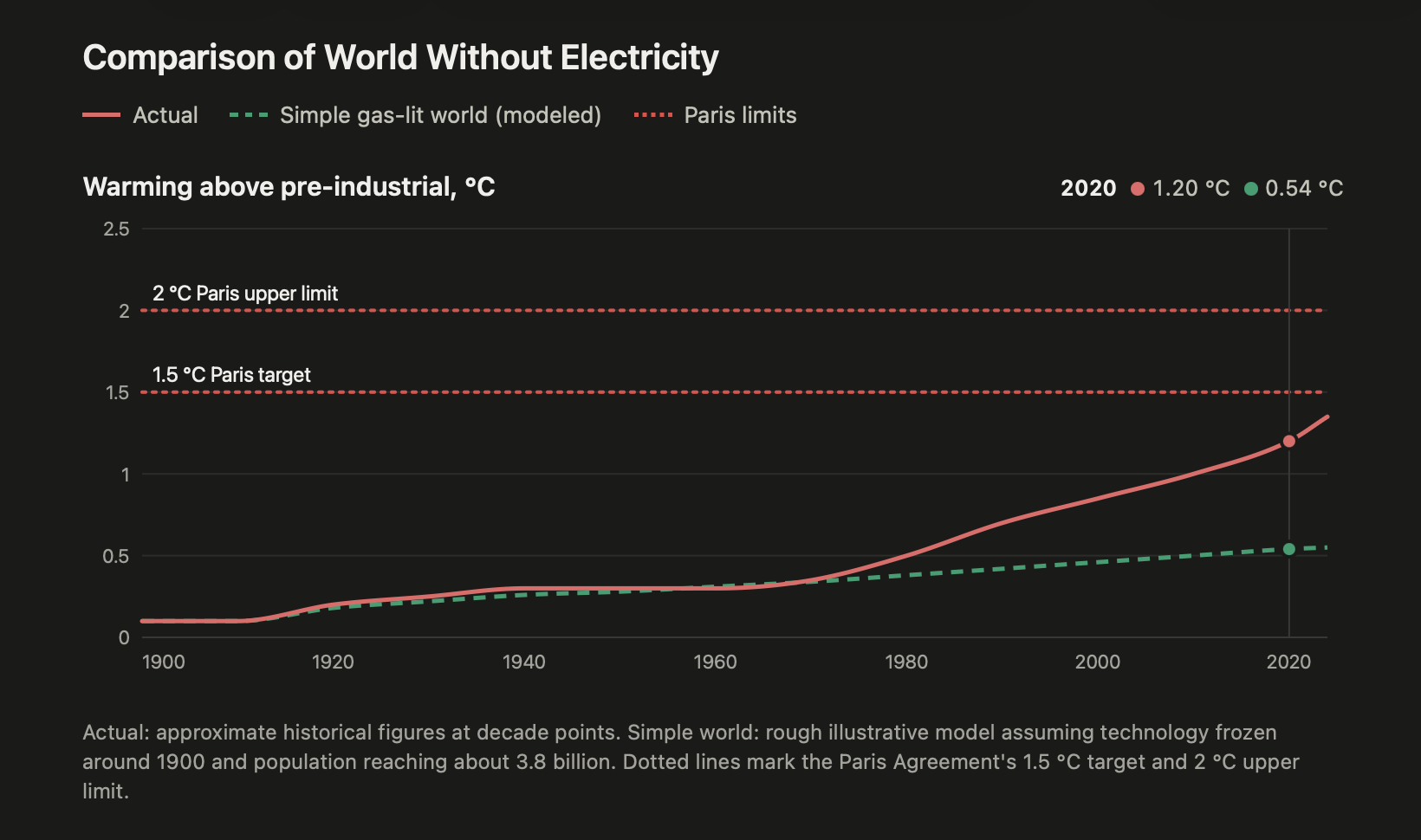
Take electricity. Humans don’t really “need” electricity. There existed an alternative: gas illumination and candles. In fact, if humans had not adopted electricity, arguably the world would be much better off in terms of CO2 emissions and less at risk of catastrophic climate change.
Using AI for assistance (even though I didn’t technically “need” to use it), I created this highly simplified comparison of the world we live in with electricity and a hypothetical world if humans had not adopted electricity and remained “the way things were” with gas-illumination and candles. As Figure 1 below shows, in terms of CO2 emissions and resulting climate change, the world would have been far better off without the adoption of electricity. That is, if CO2 emissions were the sole criterion. Indeed, we’d be much less close to catastrophic climate change under the Paris Agreement targets.
Figure 1. Comparison of Estimated Climate Change in World With and Without Electricity

At the time electricity was introduced, some people resisted. Electrical wires were a blight on cities — and electrocution, in fact, caused accidental deaths. In 1889, one worker, John Feeks, faced a gruesome death, suspended on a pole with high-voltage wires. The New York Times ran a front page story on the tragedy, calling it a “horrifying spectacle.” It was.
The deaths and devastation caused by electricity have not stopped. They’ve worsened. Downed power lines and failed transmission towers for electricity are a major cause of wildfires that have decimated millions of acres and resulted in several hundred deaths since 2009. Where I live, rolling blackouts are now a typical “safety” measure to avoid the risk of wildfires.
Beyond the danger electricity posed, people objected to the change from gas illumination. As Robert Louis Stevenson lamented in “A Plea for Gas Lamps,” electricity was “[h]orrible, unearthly, obnoxious to the human eye; a lamp for a nightmare! Such a light as this should shine only on murders and public crime, or along the corridors of lunatic asylums, a horror to heighten horror.” Others, such as engineer William Henry Preece, doubted the feasibility of electricity, that it would work. During the 1930s, the Rural Electrification Administration reported that most farmers “do not feel that electricity is worthwhile to them even though they can often well afford it.” (Kline, at p. 334).
Electricity was “[h]orrible, unearthly, obnoxious to the human eye; a lamp for a nightmare! Such a light as this should shine only on murders and public crime, or along the corridors of lunatic asylums, a horror to heighten horror.
Robert louis stevenson, A Ple a for gas lamps
To look at it only once is to fall in love with gas, which gives a warm domestic radiance fit to eat by.
Mankind, you would have thought, might have remained content with what Prometheus stole for them and not gone fishing the profound heaven with kites to catch and domesticate the wildfire of the storm. Yet here we have the levin brand at our doors, and it is proposed that we should henceforward take our walks abroad in the glare of permanent lightning.
This calculus doesn’t even consider all the additional societal ills electricity later produced by powering, let’s say, addictive social media and, yes, AI. Maybe humans should have pulled the plug on electricity?
Of course, we have to consider some of the major societal benefits electricity yielded, including increased productivity and economic growth, advances in modern medicine, and, relatedly, increased human lifespans.
But that’s my point. How many people today are willing to give up electricity? Probably not many. And that is so even knowing that electricity greatly contributed to massive CO2 emissions by modern society that, according to some experts, has pushed the planet to the brink. Many of our concerns about extraordinary energy consumption would be solved, instantly, by the elimination of electricity. So would social media addiction and other ills made possible by electricity.
the stark tradeoffs with ai
The tradeoffs of AI might even be starker. The advances in curing cancer in the past few years (such as with Merck and Moderna’s treatment for skin cancer in a Phase 3 trial) have been promising. As the Cancer Research Institute explained: “While the fight against cancer is an ongoing challenge, AI is helping to reshape how we understand, diagnose, and treat it in ways never before thought possible.“
AI is also advancing research in developing new drugs, as well as analyzing diseases, such as Parkinson’s, that have proven intractable to researchers. As Michele Vendruscolo, professor in biophysics and co-director of the Centre for Misfolding Diseases at the University of Cambridge, explained: “We can analyse this data and make very accurate predictions about the way candidate molecules will bind to the target at a scale that was unthinkable until a few years ago.”
So, too, with Alzheimer’s disease. Daifeng Wang, a UW–Madison professor, is using AI to “decipher the molecular underpinnings of the condition by linking changes in brain cells to Alzheimer’s symptoms, identifying specific genes and cell populations involved in disease progression and cognitive resilience, and creating gene roadmaps for individuals with the condition,” according to UW. The AI tools, “[c]alled PASCode and iBrainMap,” were described in “in Nature Medicine and Nature Communications, respectively, … and [were] designed using an emerging AI model called graph neural networks and built on a dataset of more than 6.3 million cells from the brains of nearly 1,500 autopsy donors.”
Yet, at the same time, AI might enable bad actors to develop biological weapons. That’s a tradeoff.
other modern technologies pose tradeoffs, too
I’ve focused on electricity. We could run this same tradeoff analysis for many common technologies that people have no hesitation in using today, including plastics, cars, trains, and airplanes. Few people in modern societies can say they don’t use any of these technologies.
Taking 1 cross-country flight consumes as much energy as 5 million AI text prompts (according to the analysis I ran using AI). So the average American can have a far greater impact on energy conservation by refusing to fly as opposed to refusing to use AI. So, will you volunteer to give up flying — and convince your friends and family to do so as well?

None of this is meant to diminish the potential harms and risks posed by AI. But it’s important to appreciate that every disruptive technology poses stark tradeoffs. Advancing human knowledge, including in promising new research to find cures for cancer, Parkinson’s, and Alzheimer’s disease, provide reason enough for the continued advancement of AI. Even finding a cure to one of these diseases would be a defining discovery of this century.
The “we don’t need this technology” trope can be said for every disruptive technology since at least electricity. Electricity was a technology that humans never “needed.” Indeed, humans survived for generations with candles.
As the German art historian Wilhelm Hausenstein wrote during World War II, “Candles give as much light as things need in order to be what they are – optimally, so to speak – and allows them to retain their poetic element.” (Wilhelm Hausenstein, Licht unter dem Horizont, Tagebücher vxon 1942 bis 1946 (Munich: Prestel Verlag, 1967), quoted in Schivelbusch, Disenchanted Night, p. 178.)

