One copyright case that has not received enough attention is EVOX Productions v. Stanford University. EVOX contends that its stock car images were included in 2 datasets compiled by Stanford researchers for AI research: (1) ImageNet and (2) a smaller “Stanford cars dataset.” Both datasets were allegedly posted by Stanford on webpages to share with other researchers to enable peer review.
the imagenet dataset
As I’ve written before, Stanford University Professor Li Fei-Fei, who is not named in the lawsuit, is widely credited for advancing AI deep learning by overseeing the compilation of this important ImageNet dataset that was used by AI researchers in computer vision in an annual ImageNet competition.The AlexNet paper by Alex Krizhevsky, Ilya Sutskever, and Geoffrey Hinton, submitted to this competition, is also widely considered one of the most important research papers in the history of AI research. It is one of the most cited AI research papers ever. And, yes, that’s the same Geoffrey Hinton who later was awarded the Nobel Prize for his advancements in AI research. Both the ImageNet dataset and the AlexNet paper were instrumental in showing how increasing the size of datasets can improve the capabilities of AI models, in a strategy known as scaling.
stanford cars dataset
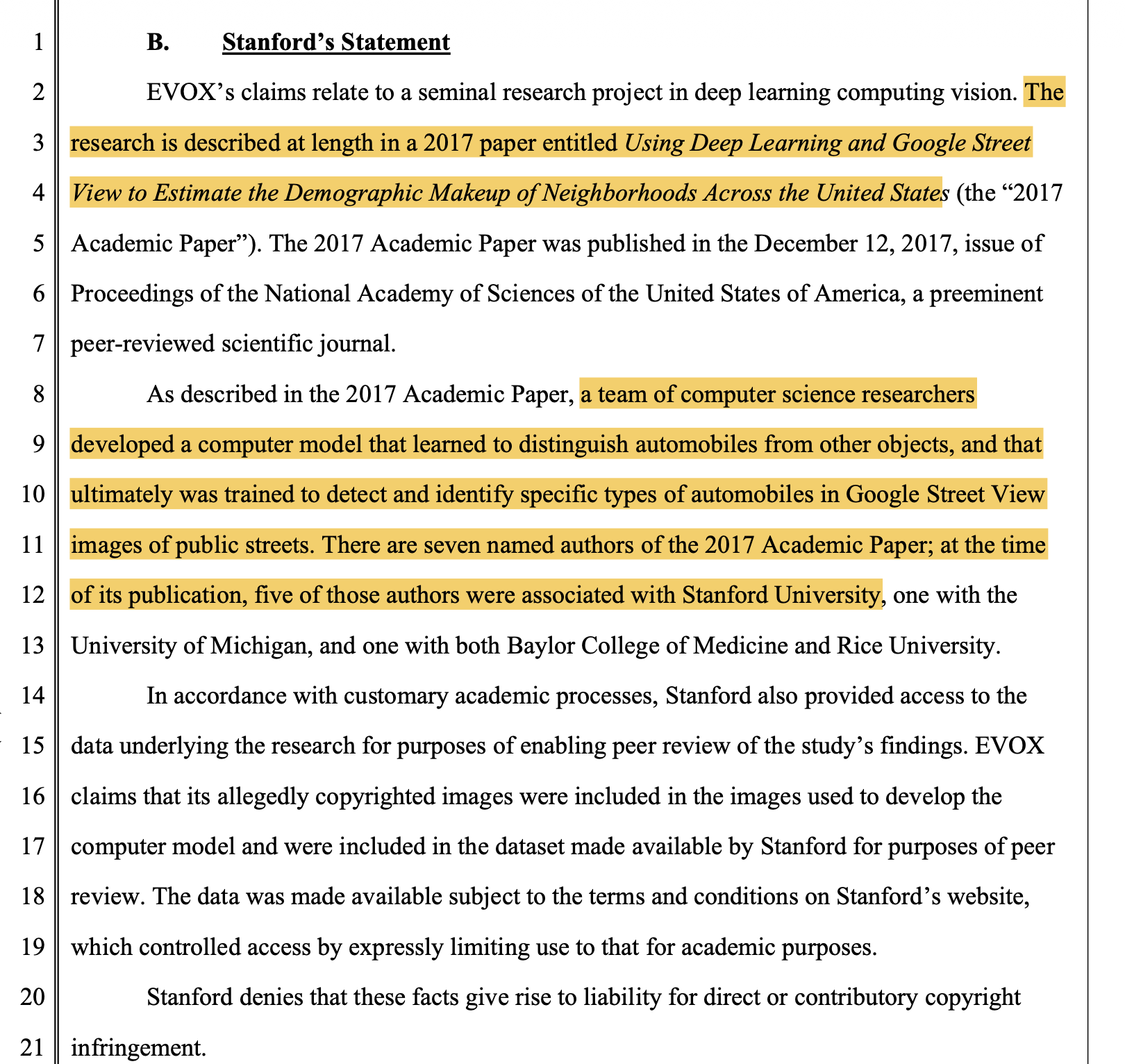
In its most recent filing for the Joint Case Management Statement, Stanford explains the origin of the smaller car dataset below. The 2017 paper entitled Using Deep Learning and Google Street View to Estimate the Demographic Makeup of Neighborhoods Across the United States was co-authored by leading AI researchers, including the lead investigator Timnit Gebru and Fei-Fei Li. No Stanford researcher is named as a co-defendant in this lawsuit.
My highlighting added to Stanford’s Statement:

And here is a list of all AI researchers on the paper, which lists the lead researcher as Timnit Gebru:

If what the Stanford researchers did is not fair use as EVOX Productions contends, then all universities in the United States that conducted or are conducting any AI training of models, or any use of datasets of unlicensed copyrighted works of any kind, will likely be at risk of liability. I explain why in my latest article on the “Fair Use and the Origin of AI Training.” The article explains how every insight in AI training and the practice of using unlicensed datasets traces back to universities.
Although speaking generally (and not about the copyright issues at issue here), Fei Fei Li described well the origin of AI traces to “the universities” and “open publication domain”:
I think finding copyright liability for this type of AI research activity would be the wrong result and terrible for the United States’s national interest in maintaining its position as the world leader in AI. But, until the court resolves this case (and other cases involving AI research uses of datasets), it remains an open legal question.
And, if Stanford loses, it’s possible all universities in the United States would lose as well for every unlicensed use of copyrighted materials in AI research. Such a drastic result could be disastrous for AI research and development in the United States. If academic research to advance the state of the art of one of the most transformative technologies of the 21st century is not the type of “research” that Section 107 expressly recognizes and was meant to foster, then it’s hard to imagine what is.
maximum statutory damages if willful infringement = $1.215 billion
It looks like the maximum statutory damages EVOX could potentially seek is $1,215,000,000. That’s based on alleged 8,100 images x $150,000 max per work if willful infringement is found. EVOX even alleged willful infringement in its complaint and references it below:

DOWNLOAD THE JOINT CASE MANAGEMENT STATEMENT:
Related Story:

One response to “AI research paper by Timnit Gebru, Li Fei-Fei, along with its dataset, is at center of copyright suit by EVOX Productions. Was it fair use or will Stanford University be liable for copyright infringement?”
[…] AI research paper by Timnit Gebru, Li Fei-Fei, along with its dataset, is at center of copyright sui… […]