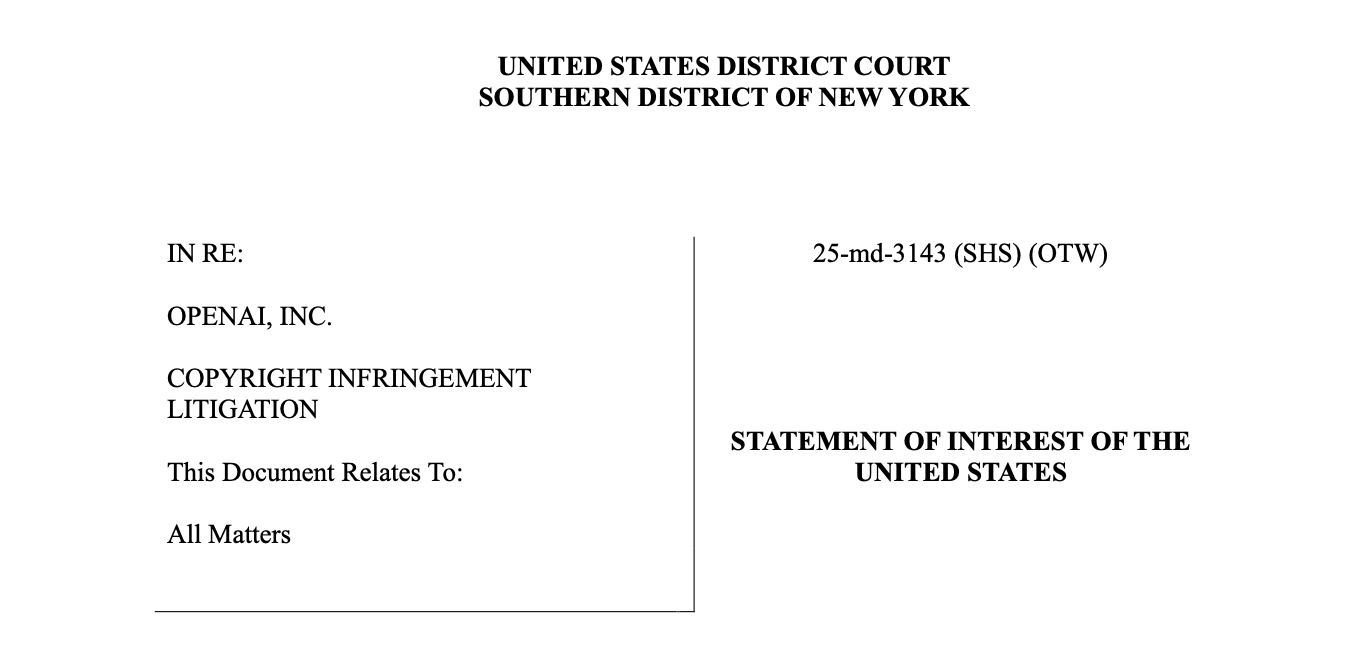
Late evening, pursuant to 28 U.S.C. § 517, the United States just filed a Statement of Interest representing “the interests of the United States” in the fair use in AI training. The filing was in In re OpenAI Copyright Infringement Litigation before Judge Stein as the case heads into the summary judgment phase. The 19-page Statement makes several points, summarized below:
The national interest in AI development
- National interest in AI: The United States “has a strong interest in continuing to develop a robust and competitive artificial intelligence industry that sets the standard for the practice and procedure of AI use globally.” (p. 1) “To start, effective integration of AI will be critical for U.S. national security capabilities.” (p. 2). “Constraining LLM development under misunderstanding of fair use doctrine would thwart such creative and scientific progress while hindering American prosperity and economic mobility.” (p. 3) “It would cause other harms, too. An erroneous fair use ruling would hamper competition in the market for LLMs, because only the largest technology companies might have the capital necessary to pay licensing fees….It is not in the public’s interest for the largest technology companies to have an oligopoly on LLM training due to licensing entry barriers that function primarily as large subsidies for old mainstream media companies.” (p. 4)
factor 1: Highly Transformative purpose in ai training
- The United States takes the view that AI training of “LLMS On Written Works Is Exceedingly Transformative.“ (p. 10): “The copying of protected text articles as part of training an LLM is a use of a different kind or character that is ‘transformative—spectacularly so.’ Bartz v. Anthropic PBC, 787 F. Supp. 3d 1007, 1021 (N.D. Cal. 2025).” (p. 10). The United States also cites Kadrey v. Meta Platforms, Inc., 788 F. Supp. 3d 1026, 1044 (N.D. Cal. 2025) (AI training is “undoubtedly ‘highly transformative.’”). Then the United States cites and discusses the Supreme Court’s decision in Google v. Oracle.
Excerpt from United States’ Statement (p. 11):

Factor 4: Market “dilution” is a “deeply flawed” theory based merely on genres
- The United States takes the view that the new theory of “market dilution” under Factor 4 of fair use being advanced by some copyright holders is “deeply flawed” because
- (i) outputs must be analyzed as a separate use from AI training under Warhol‘s use-by-use analysis of fair use (therefore it is not relevant in analyzing the training uses) and
- (ii) outputs that are not substantially similar but are simply in the same genre of works used to train the AI model do not constitute cognizable market harm “in the relevant sense” under Factor 4 of fair use.
Excerpt from United States’ Statement (pp. 13-18):


Obviously, there is much to digest.
DOWNLOAD THE UNITED STATES’ STATEMENT OF INTEREST:
Statement of Interest of the United States on Fair Use (Sept 1 2026) gov.uscourts.nysd.640396.1682.0Download
Related Stories:

6 responses to “United States files Statement of Interest in OpenAI lawsuits: AI training is fair use; “dilution” is “deeply flawed” theory, in the view of the United States.”
[…] United States files Statement of Interest in OpenAI lawsuits: AI training is fair use; “diluti… […]
[…] United States files Statement of Interest in OpenAI lawsuits: AI training is fair use; “diluti… […]
[…] United States files Statement of Interest in OpenAI lawsuits: AI training is fair use; “diluti… […]
[…] United States files Statement of Interest in OpenAI lawsuits: AI training is fair use; “diluti… […]
[…] ROSS Intelligence informs Third Circuit of United States’ Statement of Interest in OpenAI suits United States files Statement of Interest in OpenAI lawsuits: AI training is fair use; “diluti… […]
[…] United States files Statement of Interest in OpenAI lawsuits: AI training is fair use; “diluti… […]