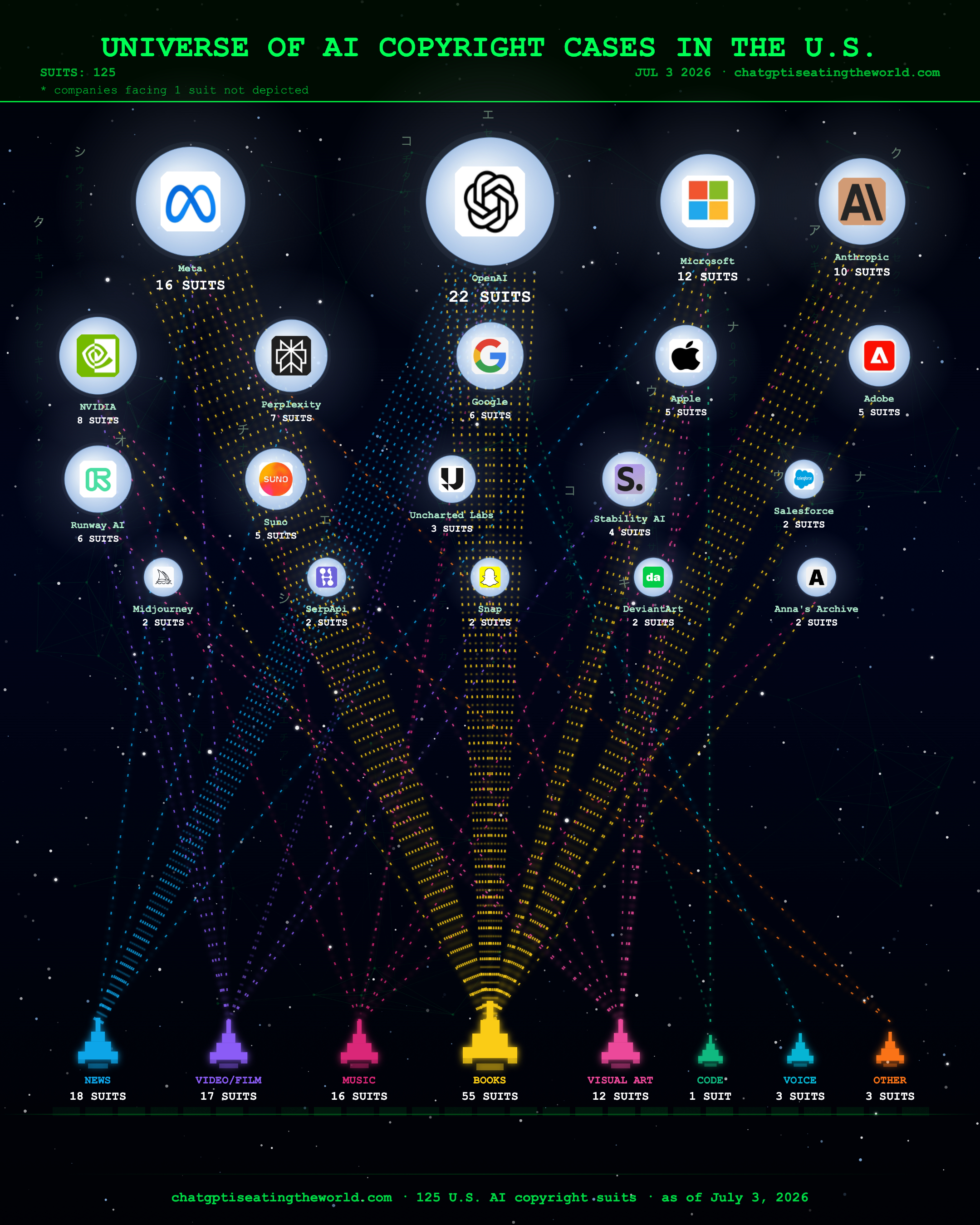
On the 250th birthday of the United States of America, the copyright lawsuits filed against AI companies hit 125. A fitting number.
This number shows, not only that the U.S. is the global epicenter of copyright litigation against AI companies, but also that the United States is the land of litigation. To commemorate this moment, we created a new infographic depicting the AI companies facing the most lawsuits, as well as the group of plaintiffs that have filed the most lawsuits.
OpenAI is No. 1 on the defense side. Book authors, No. 1 on the plaintiffs’ side:

Why Litigation Is a Good Thing
In his book Breakneck: China’s Quest to Engineer the Future, Dan Wang contrasts the United States as a “lawyerly state” with China, the “engineering state.” Wang finds fault with the U.S. lawyerly approach as “reflexively blocking everything, good and bad.” Much of his book is devoted to how it affects the AI arms race between the U.S. and China.
By contrast, I see things differently. Admittedly, I am a former litigator, so excuse my bias. But litigation and the legal system are strengths of the United States. Anyone in the United States who believes they are aggrieved can file a lawsuit (at least with the assistance of a lawyer). And they can have their legal complaint decided by a judge, or, if the case goes to trial, a jury of their peers. Yes, members of one’s own community are given the power to decide the facts and verdict in lawsuits under the Seventh Amendment of the U.S. Constitution. In the world, the United States stands virtually alone in guaranteeing as a constitutional right the right to a jury trial even in civil lawsuits.
The U.S. legal system is far from perfect.
But when the underlying controversies evoke strong, deep-seated emotions, if not outright animus against the other parties, the U.S. legal system performs an indispensable role in resolving disputes.
Legislatures have roles to play in tackling major controversies that may require new regulations. So, parties unhappy with the results in court cases or with the existing laws have another forum to air their voices.
Both institutions help to channel disagreements in ways that serve democracy. Disagreements and disputes are made public—for all to see and potentially join.
