The Supreme Court’s recent clarification in Cox Communication v. Sony Music Entertainment that claims for contributory infringement under copyright law requires proof of intentional conduct by a provider of a service has now entered the picture in one of the most important set of cases, In re OpenAI Copyright Infringement Litigation.
As we predicted, Cox is likely to affect many of the copyright lawsuits against AI companies in which claims of contributory infringement are being asserted.
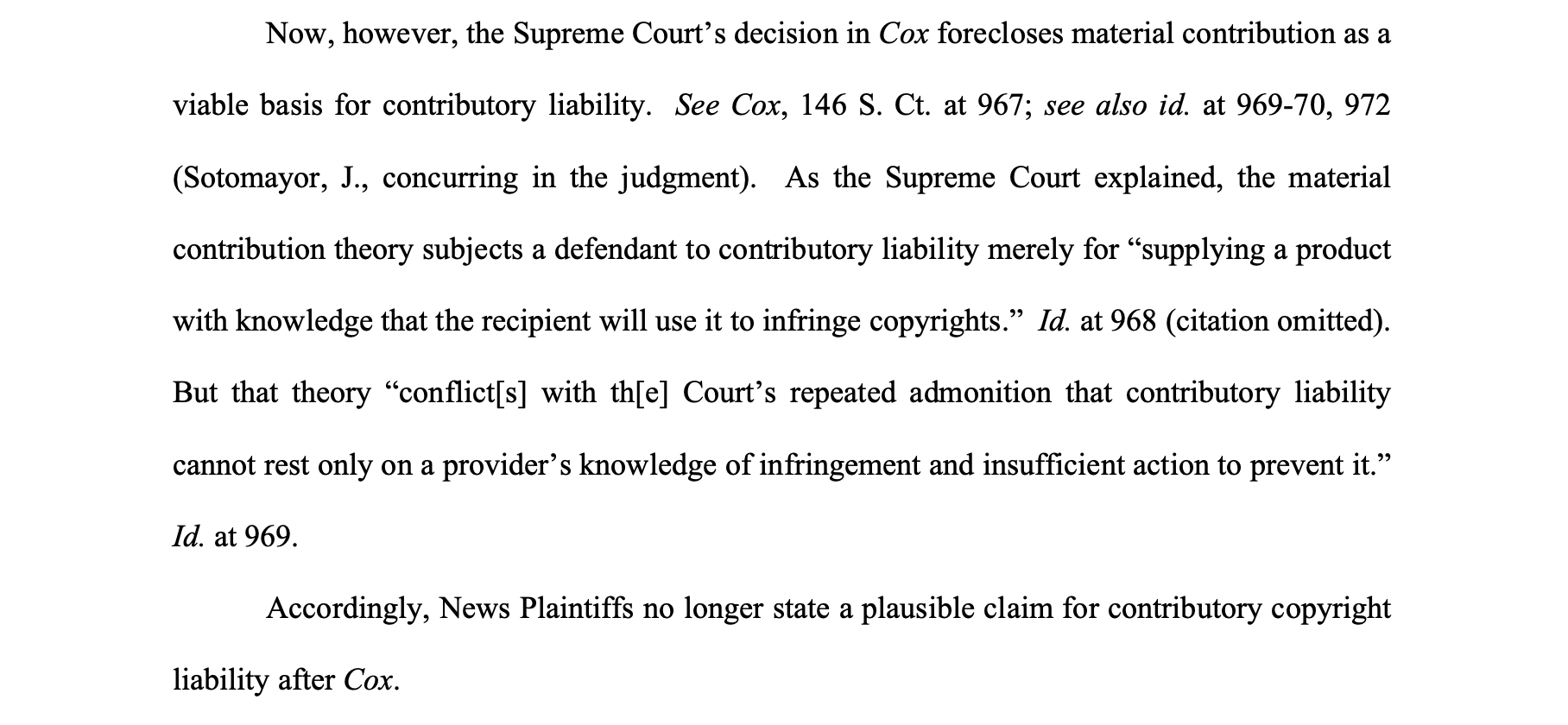
Now, OpenAI is seeking a judgment on the pleadings that the New York Times and other plaintiffs in the MDL litigation asserting contributory infringement claims cannot proceed on that theory, which ultimately rests on some prior lower court case law involving a standard of (1) the defendant’s knowledge plus (2) material contribution to third parties’ direct infringement.
OpenAI’s brief seems quite strong in its explanation of the Supreme Court’s decision in Cox.
Whether or not the New York Times can salvage its contributory infringement claim, post-Cox, remains to be seen.
Excerpt of OpenAI’s brief:


DOWNLOAD OPENAI’S BRIEF
