Back in December 2024, OpenAI probably had different hopes when seeking to transfer all the copyright lawsuits against it — then only 8 lawsuits — to one Multi-District Litigation court.
Flash forward a year later. And OpenAI’s decision looks like it backfired. The copyright lawsuits have doubled since then, to now 16 lawsuits against OpenAI with no end in sight. But, even worse, the transfer to one MDL court has put OpenAI’s eggs all in one court, so to speak.
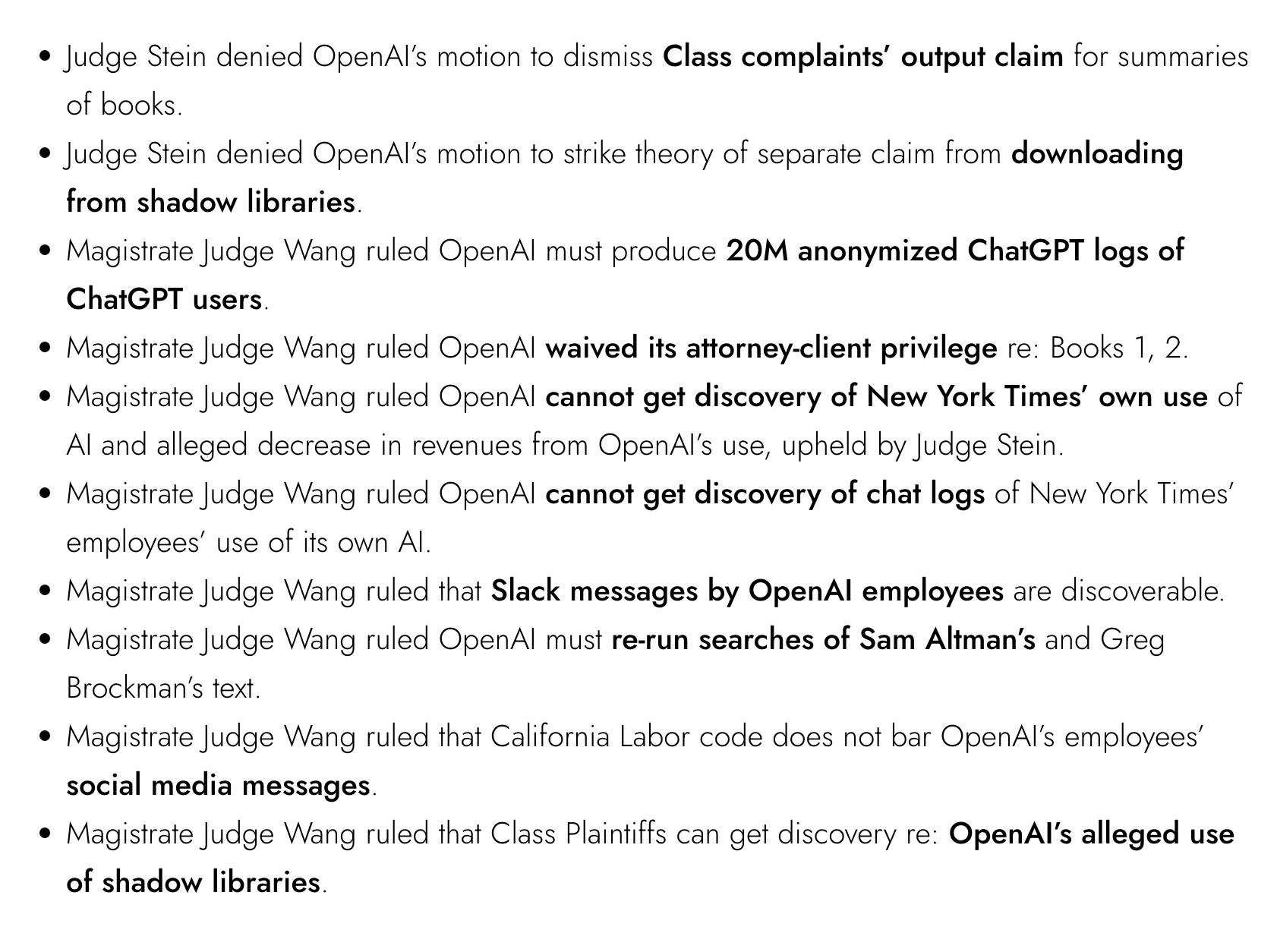
That means Magistrate Judge Ona Wang for discovery disputes and Judge Sidney Stein for dispositive motions and appeals of discovery orders. OpenAI has lost nearly every major dispute in discovery and substantive motions in the MDL court. A brief recap of some of the major losses:
- Judge Stein denied OpenAI’s motion to dismiss Class complaints’ output claim for summaries of books.
- Judge Stein denied OpenAI’s motion to strike theory of separate copyright claim from downloading from shadow libraries.
- Magistrate Judge Wang ruled OpenAI must produce 20M anonymized ChatGPT logs of ChatGPT users‘ chats and denied OpenAI’s request for reconsideration.
- Magistrate Judge Wang ruled OpenAI waived its attorney-client privilege re: Books 1, 2.
- Magistrate Judge Wang ruled OpenAI cannot get discovery of New York Times’ own use of AI and alleged decrease in revenues from OpenAI’s use, upheld by Judge Stein.
- Magistrate Judge Wang ruled OpenAI cannot get discovery of chat logs of New York Times’ employees’ use of its own AI.
- Magistrate Judge Wang ruled that Slack messages by OpenAI employees are discoverable.
- Magistrate Judge Wang ruled OpenAI must re-run searches of Sam Altman’s and Greg Brockman’s text.
- Magistrate Judge Wang ruled that California Labor code does not bar OpenAI’s employees’ social media messages.
- Magistrate Judge Wang ruled that Class Plaintiffs can get discovery re: OpenAI’s alleged use of shadow libraries.
There may be other major losses for OpenAI even beyond this list. But it should give you an idea of just how bad things are going for OpenAI before the MDL court. Real bad.
As the list shows, Plaintiffs have won just about all their major discovery requests from OpenAI, including based on the waiver of OpenAI’s attorney-client privilege, while OpenAI has lost just about all its major discovery requests from Plaintiff(s).
The MDL transfer eliminated the diversity of judicial viewpoints that likely would have arisen had the cases been litigated in their court of original filing. That includes in the Northern District of California: Judge Chen, Judge Araceli Martinez-Olguin, and Judge Davila. In Delaware: Chief Judge Connolly. In the Southern District of New: Judge Rakoff and Judge McMahon. And, of course, the respective magistrate judges who work with each judge.
Such diversity of judicial viewpoints is especially valuable in complex cases raising novel issues of law. Some of the above decisions are both controversial and contestable under the law. Especially some of the bigger discovery rulings, a different court might take a different view. But, now, OpenAI will never find out.
Of course, if there’s anyone to blame, it’s OpenAI. OpenAI is the one who sought transfer to one MDL court. Putting your eggs in one basket is never a good idea in life or the law.
OpenAI made its own bed. Now it has to lie in it.
