With the help of ChatGPT, we have compiled a list of the most memorable lines from ROSS Intelligence’s opening brief filed in the Third Circuit on Monday. Some are pithier than others. All advance ROSS’s positions in effective ways.
It would be hard to pick one most memorable line. Being a nerdy copyright scholar, I’ll go with this:
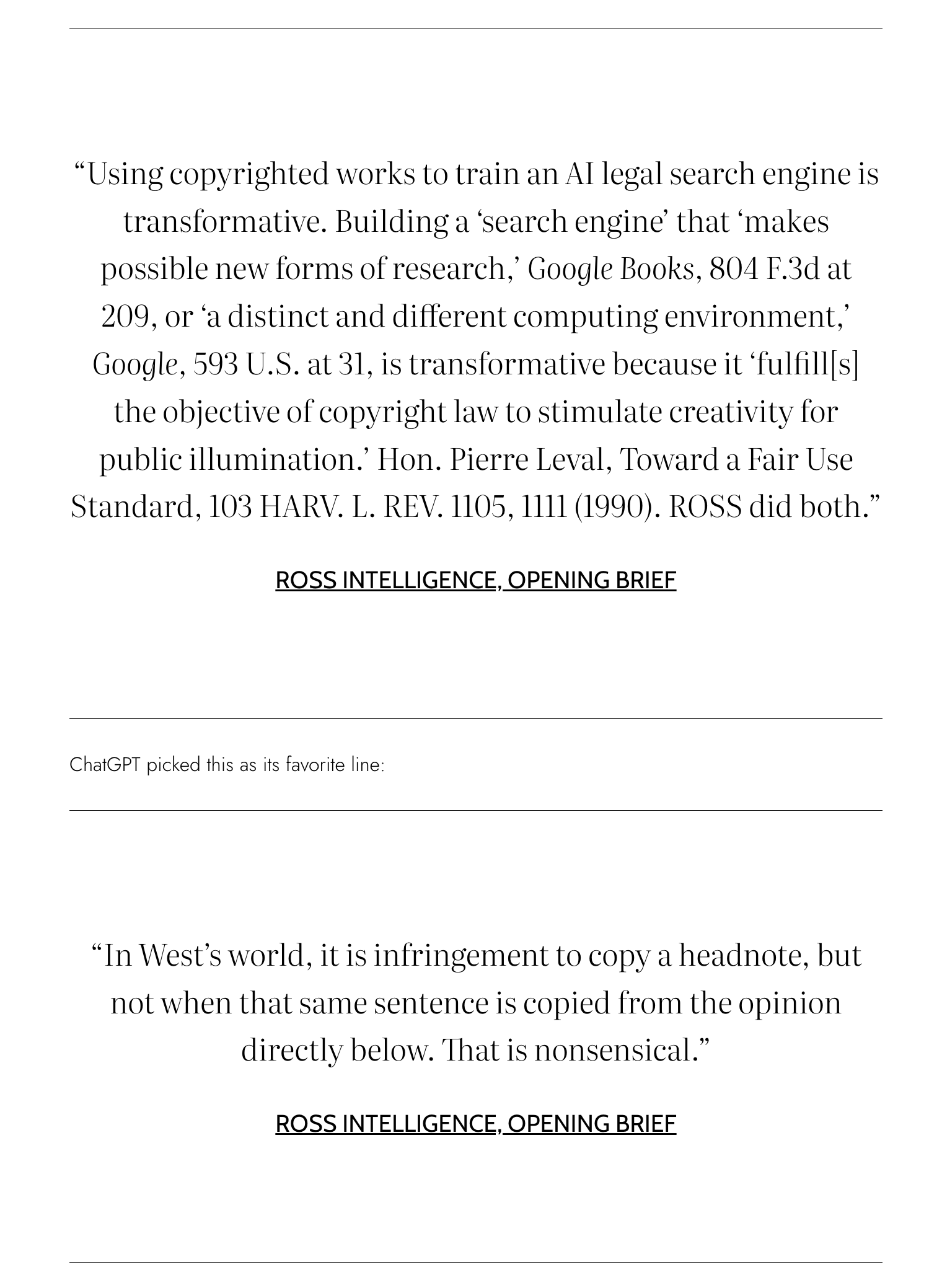
“Using copyrighted works to train an AI legal search engine is transformative. Building a ‘search engine’ that ‘makes possible new forms of research,’ Google Books, 804 F.3d at 209, or ‘a distinct and different computing environment,’ Google, 593 U.S. at 31, is transformative because it ‘fulfill[s] the objective of copyright law to stimulate creativity for public illumination.’ Hon. Pierre Leval, Toward a Fair Use Standard, 103 HARV. L. REV. 1105, 1111 (1990).
ROSS INTELLIGENCE, OPENING BRIEF
ROSS did both.”
ChatGPT picked this as its favorite line:
“In West’s world, it is infringement to copy a headnote, but not when that same sentence is copied from the opinion directly below. That is nonsensical.”
ROSS INTELLIGENCE, OPENING BRIEF
ROSS overall argument
- “This case asks whether West Publishing can use copyright law to prevent transformative innovation and protect its dominant market share.”
- “This Court should reverse. The headnotes are not copyrightable because ‘no one can own the law.’ Georgia v. Public.Resource.Org, Inc., 590 U.S. 255, 256 (2020). And ROSS’s minimal use of the headnotes was quintessential fair use—it radically promoted scientific progress without impacting any market for those headnotes because no such market existed. 17 U.S.C. § 107. ROSS also served the public good—it increased access to justice and sparked innovation in a market that lacked competition.”
- “If allowed to stand, the district court decision would put an end to that, with sweeping consequences for innovation—not just in legal research, but in artificial intelligence more broadly.”
- “In sum, the decision below reads copyrightability too broadly and fair use too narrowly. Either error warrants reversal. The two combined compel it.”
- “The district court’s decision here disrupts copyright law’s purpose: ‘to create the most efficient and productive balance between protection (incentive) and dissemination of information, to promote learning, culture and development.’ Whelan Assocs., Inc. v. Jaslow Dental Lab’y, Inc., 797 F.2d 1222, 1235 (3d Cir. 1986). ROSS’s use benefits the public—it increases access to justice and advances AI technology, which, as a whole, is critical to our national security.“
On history of AI development and ROSS
- “Today, artificial intelligence is all the rage. But a decade ago, to many, it was a fantasy. The founders of ROSS Intelligence, Inc. were members of the small group who drove the technological advancements that led to the current AI boom. They knew that AI was the future. And they also knew that AI could transform the legal industry that was in dire need of competition and innovation.”
- “ROSS’s innovations embody the Copyright Act’s ‘ultimate aim’: ‘to stimulate artistic creativity for the public good.’ Twentieth Century Music Corp. v. Aiken, 422 U.S. 151, 156 (1975).”
- “Today’s artificial intelligence revolution springs from research at the University of Toronto led by Geoffrey Hinton, often referred to as the Godfather of AI, Alex Krizhevsky, an innovator in deep learning technology, and Ilya Sutskever, who would later cofound OpenAI and release ChatGPT.”
- “Andrew Arruda, Jimoh Ovbiagele, and Pargles Dall’Oglio, joined forces and entered the challenge. Using their talents and institutional resources, the group applied Watson to solve a problem that has plagued lawyers for centuries: Legal research is difficult and takes a lot of time.”
- “What if Watson could be used to train a model to learn the law, think like a lawyer, and answer questions? Exit: Boolean and key word searches. Enter: AI legal searches. The trio, who built their model in the same labs that Hinton, Sutskever, and Krizhevsky built their model, placed second in the competition.”
On national importance of AI training
- “The ROSS AI legal search engine rests on the same fundamental technology as any AI model, and that technology requires vast quantities of training data.”
- “The district court’s decision siding with West over ROSS risks ending the American lead in AI development, a lead that is fundamental to economic success and national security.“
- “Unless the decision below is reversed, copyright law will halt AI development, which is a national priority.”
On fair use in AI training
- “Using copyrighted works to train an AI legal search engine is transformative. Building a ‘search engine’ that ‘makes possible new forms of research,’ Google Books, 804 F.3d at 209, or ‘a distinct and different computing environment,’ Google, 593 U.S. at 31, is transformative because it ‘fulfill[s] the objective of copyright law to stimulate creativity for public illumination.’ Hon. Pierre Leval, Toward a Fair Use Standard, 103 HARV. L. REV. 1105, 1111 (1990). ROSS did both.“
- “Time and again, courts have held that using outdated technology as a base to invent a modern tool that progresses the sciences is fair use.”
- “The ‘numerical representations’ and other techniques that ROSS’s founders used are the techniques taught by Professor Geoffrey Hinton and others in the University of Toronto labs. Those techniques, however, require training data—often vast quantities of it.”
- “The district court tried to cabin the scope of its holding by asserting that it was not confronted with “generative” AI technology. D.E. 770 at 19. But this case—like the ‘generative AI’ cases Kadrey and Bartz—asks whether it is fair to use copyrightable material to train an AI model.”
- “First, unless the decision below is reversed, no innovator will attempt to apply AI to new legal access projects. The public needs better access to law. And in this case, the ROSS founders used their university AI lab training to do just that.“
- “If anything, West’s steadfast refusal to license to competitors harms the AI training market by using the headnotes as ‘a lock limiting the future creativity of new programs[,] [where it] alone would hold the key.’” Google, 593 U.S. at 35.
- “If ever there was a case where the ‘general public good’ warranted reversal, this is it.”
On copyrighting headnotes summarizing uncopyrightable judicial opinions:
- “In West’s world, it is infringement to copy a headnote, but not when that same sentence is copied from the opinion directly below. That is nonsensical.”
- “West cannot evade this principle by parroting sentences from uncopyrightable judicial opinions and renaming them headnotes. This is nothing more than an attempt to steal ‘the fruits of [] judicial labors,’ which belong to the public.”
- “Here, because there are only so many ways to accurately say what the law is, ‘the creative is the enemy of the true.’”
- “In essence, the court reasoned that a sentence is not copyrightable when included in an uncopyrightable judicial opinion, but is when isolated from that passage. This is wrong.”
- “Westlaw’s headnotes are not original—in fact, that is their whole point: they are intended to (and do) replicate as closely as possible the language of uncopyrightable judicial opinions. That is good for accuracy but defeats any claim to originality.”
On ROSS’s AI legal search engine
- “The final product was ROSS’s AI legal search engine. ROSS had trained a computer to “think like a lawyer.” It allowed the public to ask a question in plain English and to get AI-driven direct, cited answers drawn from primary law without the editorial scaffolding that defines Westlaw and Lexis. ROSS “flip[ped] the research pyramid” through a new method of case retrieval. ROSS, How ROSS AI Turns Legal Research On Its Head (Aug. 6, 2019), https://tinyurl.com/ycxymr57. It learned a language … the language of the law.”
On West’s alleged tactics
- “Although the law belongs to no one (or, more accurately, to everyone), West has a long history of attempting to own it. Copyright has been West’s primary weapon.”
- “West’s behavior has not changed in the last two decades: when a competitor appears, it sues and alleges copyright infringement. West broadcasts this to the world—even when it comes to AI, the strategy remains the same: “build, buy, partner, or sue.”
- “West could not build ROSS, but it recognized its promise.”
- “So West sued. The lawsuit forced ROSS to close its doors to pay its lawyer fees. D.E. 691-14 at 11–12. Three years into this lawsuit, having removed ROSS from the market, Thomson Reuters purchased ROSS’s main competitor, Casetext, an AI legal search engine, for $650 million. It promptly shut down Casetext as an independent alternative, bundled its features into the expensive Westlaw platform, and raised its prices. Thus, while AI has broken down barriers to competition in other markets, United States v. Google, No. 20-cv-3010, 2025 WL 2523010, at *2 (D.D.C. Sept. 2, 2025), Thomson Reuters has staved off progress in this one.”
Related Stories
