On November 7, 2024, Judge McMahon in the Southern District of New York issued a major ruling dismissing Raw Story Media’s complaint for failure to have standing–for both damages and injunctive relief–to assert a DMCA CMI claim under 1202(b) without an allegation that OpenAI disseminated copies of Raw Story Media’s articles from which CMI had been removed.
Although other district courts in the Northern District of California have also dismissed 1202(b) claims brought against AI companies, they have done so, not on standing grounds, but instead, on the substantive law interpretation of Section 1202(b): namely, that it requires the removal of copyright management information (CMI) from identical copies on which the copyright holder placed the CMI (e.g., author’s name and title). Accordingly, substantially similar copies do not satisfy this requirement. This interpretation of Section 1202 avoids the possibility that every run-of-the-mill copyright infringement lawsuit alleging substantial similarity can also tack on a DMCA 1202 claim. Plus, DMCA 1202 claims do not require registration of copyrighted works, so the interpretation helps to preclude the avoidance of copyright registration for what should be an infringement claim that is dressed up as a DMCA 1202 claim. The plaintiffs in Doe 1 v. Github have filed an interlocutory appeal to the Ninth Circuit challenging this interpretation after Judge Tigar recognized there was a split in the district courts. [See here for list of orders regarding 1202 claims.]
Judge McMahon did not discuss that issue. Instead, she based her decision on Article III standing grounds, which requires the plaintiff to have suffered an injury in fact.
“What makes a harm concrete for the purposes of Article III?” TransUnion [LLC v. Ramirez], 594 U.S. at 424:
As a general matter, the Court has explained that history and tradition offer a meaningful guide to the types of cases that Article III empowers federal courts to consider. And with respect to the concrete-harm requirement in particular, this Court’s opinion in Spokeo v. Robins indicated that courts should assess whether the alleged injury to the plaintiff has a close relationship to a harm traditionally recognized as providing a basis for a lawsuit in American courts.
That inquiry asks whether plaintiffs have identified a close historical or common-law analogue for their asserted injury. Spokeo [Inc. v. Robins], 578 U.S. 330 (2016)] does not require an exact duplicate in American history and tradition. But Spokeo is not an open-ended invitation for federal courts to loosen Article III based on contemporary, evolving beliefs about what kinds of suits should be heard in federal courts.
Id. at 424-25. (internal quotations and citations omitted).
A. No standing for damages
I am not convinced that the mere removal of identifying information from a copyrighted work—absent dissemination—has any historical or common-law analogue.
TransUnion is clear: “the plaintiff’s injury [must] in fact be concrete—that is, real and not abstract. 594 U.S. at 424 (internal quotations and citations omitted). Plaintiffs allege that their copyrighted works (absent CMI) were used to train an Al-software program and remain in ChatGPT’s repository of text. But Plaintiffs have not alleged any actual adverse effects stemming from this alleged DMCA violation.
The argument advanced by Plaintiffs is akin to that of the dissent in TransUnion: “If a [defendant] breaches a [DMCA] duty owed to a specific [copyright owner], then that [copyright owner]… [has] a sufficient injury to sue in federal court.” Id. at 450 (Thomas, J., dissenting). To this, the majority of the Court said: ‘no.’ “No concrete harm, no standing.” Id. at 442. Accordingly, Plaintiffs lack Article III standing to seek retrospective relief in the form of damages for the injury they allege.
B. No standing for injunction
Defendants argue that Plaintiffs lack standing to seek injunctive relief because they fail to allege facts tending to show that the risk of ChatGPT reproducing Plaintiffs’ work, in whole or in part, absent the requisite CMI is “substantial.” See Reply, at 3.
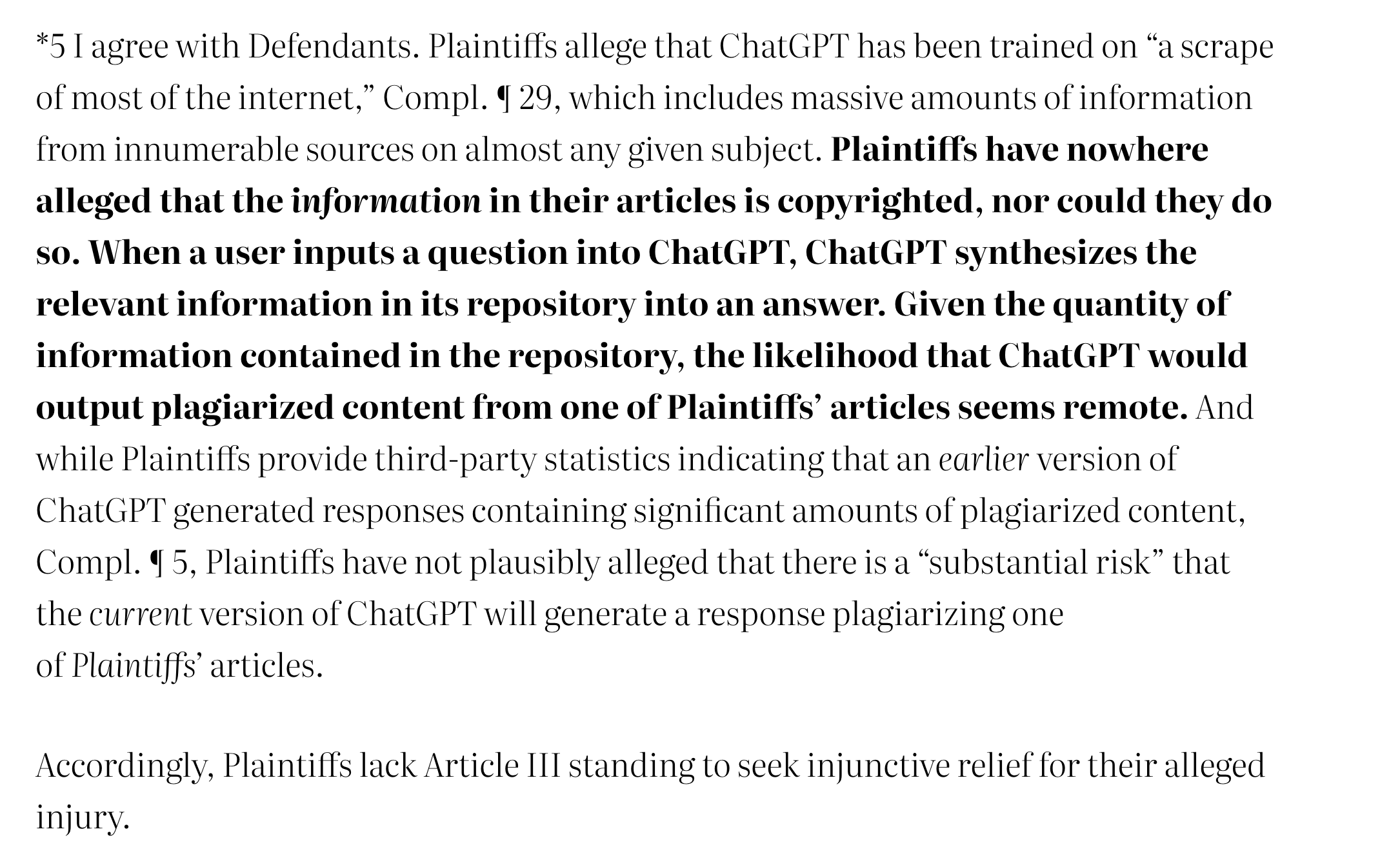
*5 I agree with Defendants. Plaintiffs allege that ChatGPT has been trained on “a scrape of most of the internet,” Compl. ¶ 29, which includes massive amounts of information from innumerable sources on almost any given subject. Plaintiffs have nowhere alleged that the information in their articles is copyrighted, nor could they do so. When a user inputs a question into ChatGPT, ChatGPT synthesizes the relevant information in its repository into an answer. Given the quantity of information contained in the repository, the likelihood that ChatGPT would output plagiarized content from one of Plaintiffs’ articles seems remote.
And while Plaintiffs provide third-party statistics indicating that an earlier version of ChatGPT generated responses containing significant amounts of plagiarized content, Compl. ¶ 5, Plaintiffs have not plausibly alleged that there is a “substantial risk” that the current version of ChatGPT will generate a response plagiarizing one of Plaintiffs’ articles.
Accordingly, Plaintiffs lack Article III standing to seek injunctive relief for their alleged injury.
C. Alleged Harms really about Putative copyright infringement
Let us be clear about what is really at stake here. The alleged injury for which Plaintiffs truly seek redress is not the exclusion of CMI from Defendants’ training sets, but rather Defendants’ use of Plaintiffs’ articles to develop ChatGPT without compensation to Plaintiffs. See Compl. ¶ 57 (“The OpenAI Defendants have acknowledged that use of copyright-protected works to train ChatGPT requires a license to that content, and in some instances, have entered licensing agreements with large copyright owners…They are also in licensing talks with other copyright owners in the news industry, but have offered no compensation to Plaintiffs.”).
Whether or not that type of injury satisfies the injury-in-fact requirement, it is not the type of harm that has been “elevated” by Section 1202(b)(i) of the DMCA. See Spokeo, 578 U.S. at 341 (Congress may “elevate to the status of legally cognizable injuries, de facto injuries that were previously inadequate in law.”). Whether there is another statute or legal theory that does elevate this type of harm remains to be seen. But that question is not before the Court today.
OpenAI’s motion to dismiss

One response to “Big ruling: Judge McMahon dismisses Raw Story’s complaint v. OpenAI on lack of standing for DMCA claim”
[…] Judge McMahon granting motion to dismiss DMCA claims in Raw Story Media v. OpenAI (Nov. 7, 2024) […]