Anthropic filed its S1 prospectus with the SEC yesterday. It has a lengthy discussion of “risk factors” related to investing in the company that spans nearly 100 pages.
Here’s what the S1 says about copyright issues:


We can break this statement into 2 sections:
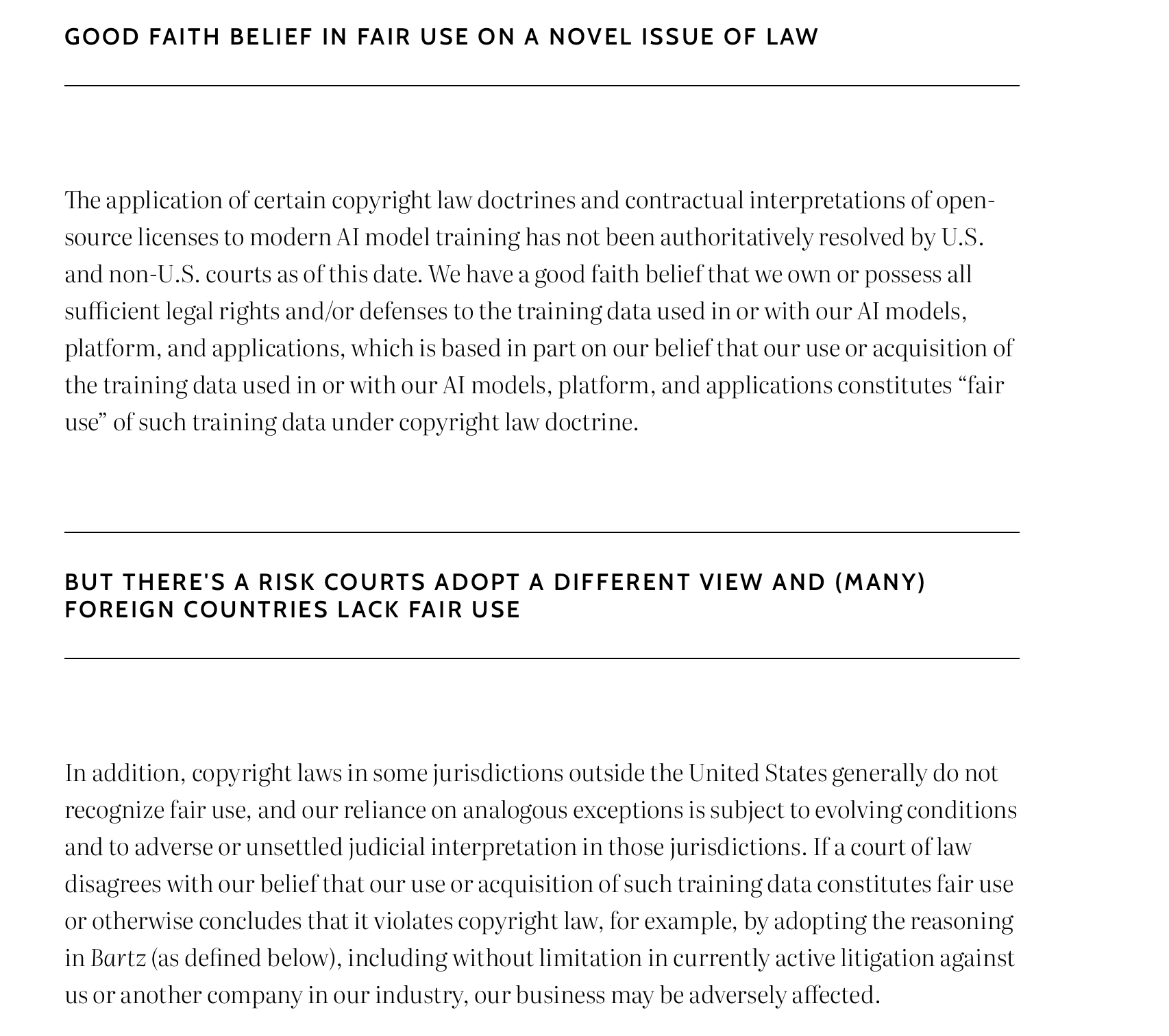
good faith belief in fair use on a novel issue of law
The application of certain copyright law doctrines and contractual interpretations of open-source licenses to modern AI model training has not been authoritatively resolved by U.S. and non-U.S. courts as of this date. We have a good faith belief that we own or possess all sufficient legal rights and/or defenses to the training data used in or with our AI models, platform, and applications, which is based in part on our belief that our use or acquisition of the training data used in or with our AI models, platform, and applications constitutes “fair use” of such training data under copyright law doctrine.
but there’s a risk courts adopt a different view and (many) foreign countries lack fair use
In addition, copyright laws in some jurisdictions outside the United States generally do not recognize fair use, and our reliance on analogous exceptions is subject to evolving conditions and to adverse or unsettled judicial interpretation in those jurisdictions. If a court of law disagrees with our belief that our use or acquisition of such training data constitutes fair use or otherwise concludes that it violates copyright law, for example, by adopting the reasoning in Bartz (as defined below), including without limitation in currently active litigation against us or another company in our industry, our business may be adversely affected.
In particular, adverse rulings in litigation involving other AI developers, regardless of the specific facts, data practices, or legal theories at issue in those cases, could establish legal precedents or interpretations of copyright law that apply broadly across the industry and limit our ability to train, develop, or deploy AI models, even if our own data procurement and usage practices differ. Such outcomes could restrict access to certain categories of training data, narrow the scope of available legal defenses, or impose new licensing, compliance, or operational requirements across the AI industry.
For example, if we cannot rely on the fair use doctrine to access copyrighted work for
training our models, we may be required to pay significant fees to obtain a license to such training data or our ability to further develop our models, platform, and applications and distribute models trained on such data at issue could be adversely affected. In addition, an adverse ruling against us or another company in our industry could result in injunctive relief that restricts our ability to use or distribute models trained on the data at issue or could require us to retrain affected models from scratch at substantial cost. If we are unable to manage the foregoing risks, our business, financial condition, and results of operations could be adversely affected.
Next, Anthropic discusses the copyright litigation, including Bartz v. Anthropic and other IP cases:


Also referred to in this section:


