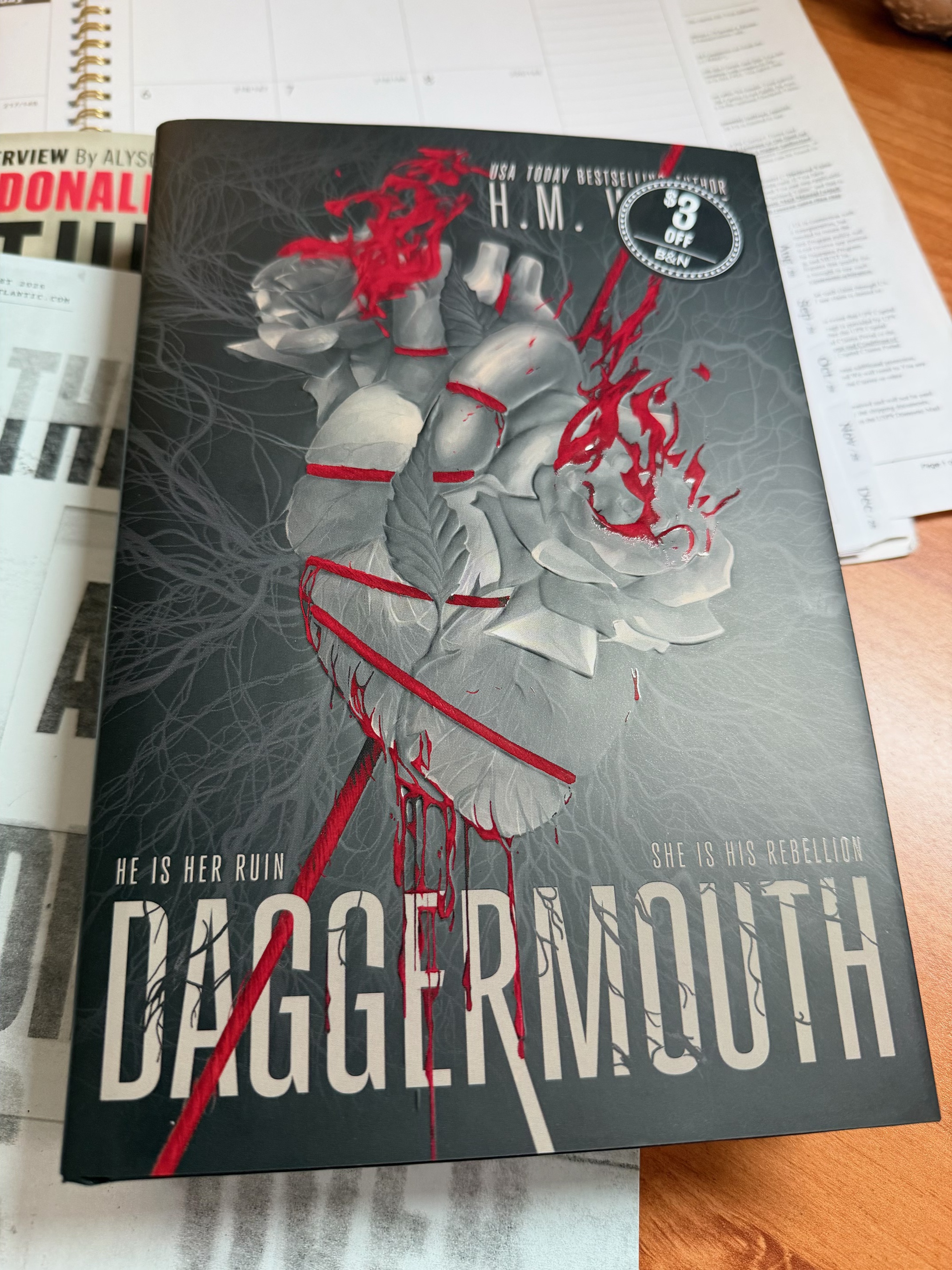
AI book witch hunt: BookTok rails v. The Atlantic’s Will Oremus article on Tuhin Chakrabarty’s study that suggests Daggermouth is partly AI-generated book based on AI detector Pangram & rare expressions. H.M. Wolfe denies it. BookTokkers defend her.
Will Oremus’s article on “Is This What Comes After AI Slop?, Daggermouth could be the first best-selling novel partly written by a chatbot.”
BookTok is a fascinating community. The Atlantic’s Will Oremus may soon found out how fascinating–and fierce. This past week, Oremus wrote a 1,500 word essay, provocatively titled “Is This What Comes After AI Slop?, Daggermouth could be the first best-selling novel partly written by a chatbot.“
Oremus was summarizing a pre-print study posted by Professor Tuhin Chakrabarty; his article was also provocatively titled, “Generative AI floods and dilutes the market for books.” Chakrabarty conducted a study on the potential effect of AI-generated books on books written without AI.
To determine if a book was AI-generated, Chakrabarty used a combination of the AI detector Pangram (which has some false positives) and the additional check of looking for “rare expressions” that supposedly are not common in human published works: “We call an expression rare when it appears in at most five Google Books volumes and is absent from a 4.7-trillion-token snapshot of the internet.”
Although Chakrabarty’s pre-print study doesn’t identify any author or title of the books analyzed as far as I can tell, Oremus apparently learned from his interview that one of the books that Chakrabarty’s study flagged as partly AI-generated was H.M. Wolfe’s Daggermouth. And Oremus’s article is almost entirely about the Daggermouth aspect instead of the entire study.
Although Oremus concedes that Pangram has false positives and that “[t]he study has yet to be peer-reviewed, and to be clear, there is no definitive proof that Wolfe used AI,” Oremus also quotes the opinion of Mohit Iyyer, a professor of computer science at the University of Maryland: “it’s ‘almost statistically impossible’ for an entirely human-written book to register as 60 percent AI” as Daggemouth’s book reportedly did.
Indeed, The Atlantic’s subtitle reads like clickbait: “Daggermouth could be the first best-selling novel partly written by a chatbot,” insinuating that the book may well be partly AI-generated.
Until recently, AI fiction has been easy to dismiss as slop—but not anymore, @WillOremus writes. He reports on how “Daggermouth,” a best-selling romance novel, is raising uncomfortable questions about the future of writing: https://t.co/3oacVrhOn6pic.twitter.com/PG9ZYGdggp
Oremus’s article on Chakrabarty AI study enrages BookTok
Well, I thought it would be a lazy Sunday but my TikTok feed lit up.
Many BookTok influencers were enraged by Oremus’s article on Chakrabarty’s AI book study. I don’t think I’m exaggerating in the use of the word “enraged.” Take a listen to some of the BookTokkers. Warning: the language may contain expletives.
And here we are AGAIN. @EmmaSkies This is a wildly irresponsible piece from The Atlantic. Putting a question mark in the headline doesn’t change that this writer is making clear accusations. I really need people to understand that at this point we don’t have any fool-proof way to prove AI generated writing beyond somebody admitting something or like wholesale leaving prompts in the book (you may laugh, but this has actually happened a few times 💀). The difference with Mia Ballard (Shy Girl) was that she openly admitted to an “editor” putting AI generated text in her book (which is not how editorial works but I’m not getting into all that again) and that her publisher dropped her completely. Pulled the book where it had already been published and stopped it where it hadn’t. Those two things together were enough for me to say okay, clearly something happened there. And even still, the way the New York Times reported on it (using Pangram) was useless! But in this case? With 0 proof, 0 action by the publisher, and 0 admittance from the author? It’s entirely speculation based on faulty software and researchers who – and maybe this assumption is just my own bias showing – probably do not read widely in this genre to be commenting on it. I don’t know why I’m still writing this caption, lemme know if you read this far, I’m gonna go make dinner. 📚 #BookTok#writing#daggermouth#romantasy#books
Everyone’s calling out the Daggermouth AI article right now — and romantasy readers, we have been here before. When Fourth Wing blew up, half of BookTok swore Rebecca Yarros couldn’t have written it that fast — that it was “just Harry Potter with dragons,” that no human plots a slow-burn, enemies-to-lovers dragon-rider fantasy in a couple of months. Sound familiar? Here’s my honest take as a dark academia romantasy writer: “it’s a mashup of every book I already love” is not the insult everyone thinks it is. The familiar beats — the morally grey love interest, the deadly magic academy, the fae court intrigue, the slow burn that wrecks you — are the entire reason I read romantasy. I don’t need the genre to reinvent itself. I want it to deliver the thing it promised, and deliver it well. Did Daggermouth or Fourth Wing use AI? I genuinely can’t tell you — and I don’t think the internet can either. But “this feels familiar” and “this feels artificial” are two very different accusations, and we keep blurring them together. So tell me — what makes a book feel HUMAN to you? I’m writing my own dark academia romantasy under S.M. Sloane — WINTERBORN: THE LETTERS — a Christmas-fae, twelve-courts, slow-burn fantasy releasing June 21, 2027. Fully human-written, occasionally unhinged. Follow along for the whole messy build. #romantasy#bookstagram#booktok#darkacademia#fourthwing
ANYWAYS—Daggermouth’s traditional publishing re-release is happening July 28th. This was a 6⭐️read with truly remarkable storytelling and a beautiful cast of characters that can only have been written by an actual human being. Please buy it and read it and ignore this nonsensical buffoonery. #daggermouth#BookTok#romancebooks
Have you read this article making unfounded accusations against HM Wolfe, author of Daggermouth? If there is more room for transparency around authors using AI – and we stop going on witch hunts in the community then this kind of thing should stop happening. What do you think? #generativeai#antiai#writertok#fantasybooktok
I am sure many of you have already heard about AI allegations against Dagger mouth. An article was published by The Atlantic which was not peer reviewed and uses software called ‘Pangram’ to detect whether the book was written using AI. So let’s get a few things straight AI software is trained on stolen human writing and so using AI to identify if a book was written by AI is problematic and inaccurate and yet when these accusations are made they impact authors careers, sales and can lead to serious bullying and harassment as was seen with Mia Ballard, who also happened to be an another woman of colour… Coincidence, I don’t think so… I want to highlight how devastating accusations like this are, especially when they are being targeted at minority and less privileged groups who already struggle to access publishing. When articles keep popping up that are targeting individuals from these groups it’s important to look at the reason why these targeted ‘AI accusations’ are happening. No I do not agree with AI in creative spaces but racist and sexist targeted witch hunts using unreliable software is not the solution to stopping AI being used in creative spaces. Using AI software to detect AI just furthers the problem, these AI companies need less support not more. Fortunately in the case of Daggermouth by H.M Wolfe the author has been supported by her publisher against these accusations as well as already having a strong stance against AI use within creative spaces. #antiai#daggermouth#aivscreativity#writerscommunity#bookstagram
Instead of reading that absurd article, I think everyone should go read Daggermouth. I really enjoyed the book. And I think journalists need to be very careful of the accusations they throw at authors and other creatives. #daggermouth#booktok
There already have been several defamation lawsuits filed by students who faced disciplinary actions by universities for alleged AI work product.
I did buy a copy of the book
Maybe the controversy worked. I did buy a copy of the book. And, yes, the book is on top of the latest issue of The Atlantic. Is that a sign of how this controversy will turn out?