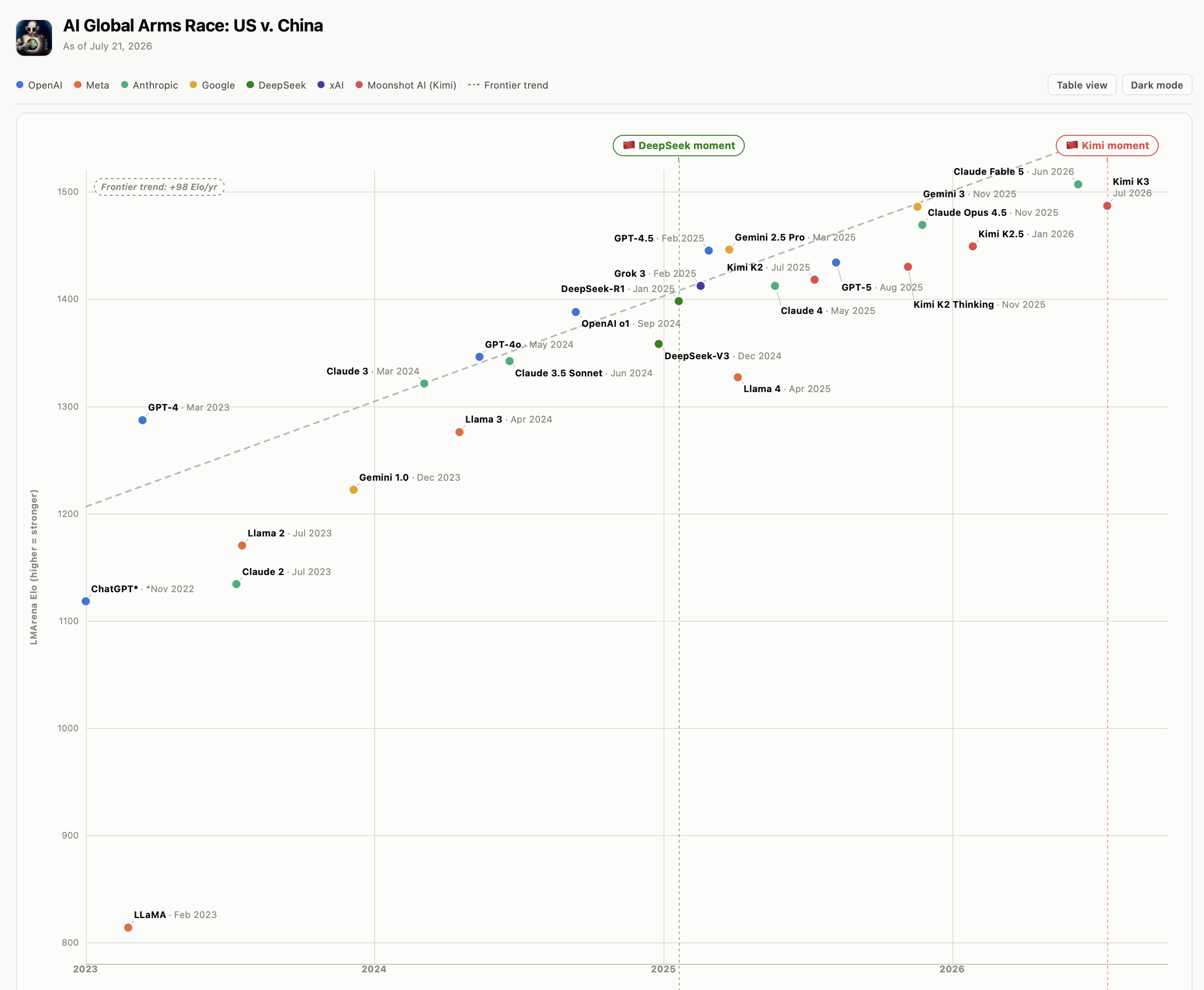
China’s ambition to be the world leader in AI is no secret. China announced these ambitions as early as 2018 in its “Next Generation Artificial Intelligence Development Plan.” It’s now clear how far China has come. Just this past week, China hosted the World Artificial Intelligence Conference (WAIC) in Shanghai, with much fanfare.
The global AI arms race intensified this past week. An AI company, Moonshot, announced its Kimi-K3 model, an open-weight model. On the Frontend Code Arena benchmark, Kimi-K3 bested Anthropic’s Fable 5 and OpenAI’s GPT-5.6 Sol model by a fair amount.
The U.S. faces AI Catch-22
The United States faces an AI Catch-22: (i) China’s best open-weight models are nipping at the heels of the leading closed models of Anthropic and OpenAI, and (ii) China’s open-weight models could become more attractive for US companies (and others around the world) to use due to cheaper cost.
According to one estimate, “The Kimi K3 API runs $3 per million input tokens and $15 per million output. Anthropic’s top model, Fable 5, costs $10 per million input tokens and $50 per million output.” That cost saving has even reportedly led Microsoft to consider a switch to Kimi over OpenAI and Anthropic. Hard to believe a U.S. company like Microsoft preferring a Chinese model over U.S. ones, but here we are.
The dilemma for U.S. companies is, on the one hand, that it may be too late to abandon their closed-AI-model on which their business plans are founded. Switching to open-weight models now could just accelerate the ability of Chinese AI companies to derive their own models more quickly from the U.S. models that then beat U.S. models in performance. Chinese AI companies would be, in effect, using U.S. AI models to beat the U.S. models and to attain global AI supremacy.
But, on the other hand, continuing with closed AI models on the current path is costly and precarious. If Chinese AI models continue to improve as fast as U.S. models, but are offered as open-weight models at significantly cheaper cost, the U.S. AI companies will be hard pressed to compete. The report about Microsoft’s consideration of Kimi could then be a canary in the AI coal mine of what may come as Chinese models continue to advance.
Here’s a preview of our timeline depicting both the “DeepSeek Moment” and the “Kimi Moment.” Both Moments show how competitive China is in the AI arms race, where there is little margin for error.


One response to “Has China outflanked the U.S. in global AI arms race? What the Kimi Moment suggests.”
Not all tasks for AI are created equal. If US closed models can maintain or even accelerate their cutting edge lead (eg, by getting to strong recursive self improvement sooner) over cheaper but slightly less powerful Chinese openweight models, US closed model providers can still charge premium prices for more complex and higher impact tasks and make larger profit, with companies utilizing openweight AI models for high volume pedestrian tasks at lower cost. No one knows for certain which approaches will ultimately succeed because it is a race to an important extent. I like the suggestion that Elon should consider converting Grok into an open weighted model (just as he had originally intended OpenAI to do), since his company already has massive compute. He could make more money from providing infrastructure that runs the open Grok model very efficiently instead of selling the AI model itself. What do others think?