Kenya’s Copyright Tribunal found insufficient evidence in the record whether a literary work for a series of “Bible Scripture Stories” that Cynthia Beldina Akoth was commissioned to write for the Aryeh Movement.
The dispute centered around who owned the copyright (if any) to the work–Akoth or Aryeh.
Kenya Copyright Board (KECOBO) originally registered the work in Aryeh’s name. Akoth appealed that decision to the Tribunal.
During the course of the proceedings, a secondary issue arose whether the literary work in question even qualified for copyright because Akoth had reportedly used AI to (help) write it. Unfortunately, the Tribunal found there was a lack of evidence in the record on how the work was created.
But, helpfully, canvassing U.S., UK, and EU law, and Kenya’s Copyright Act, the Tribunal stated:
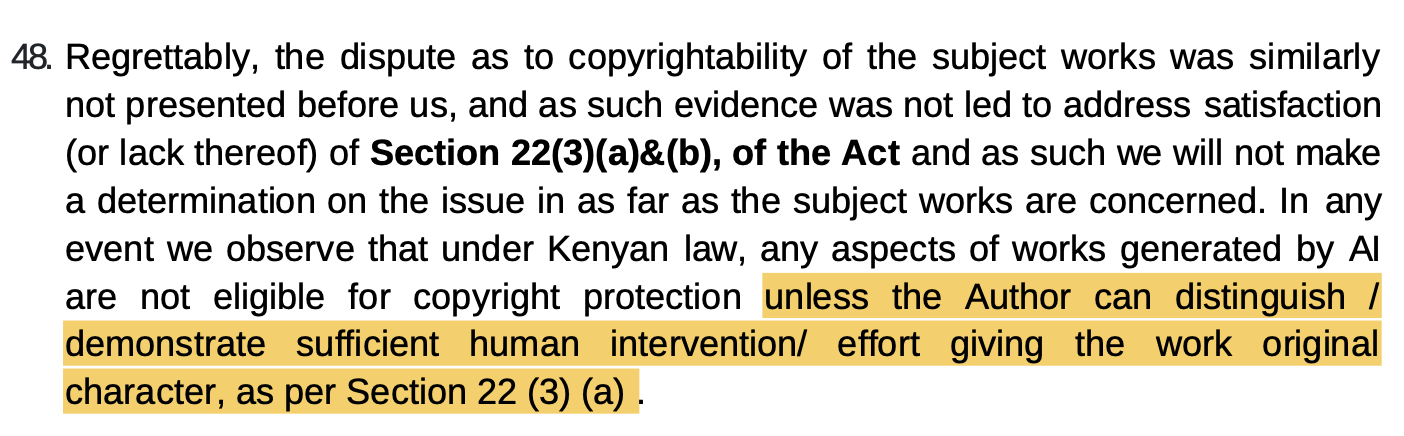
[U]nder Kenyan law, any aspects of works generated by AI are not eligible for copyright protection unless the Author can distinguish / demonstrate sufficient human intervention/ effort giving the work original character, as per Section 22 (3) (a).
And it noted earlier: “Section 22(3) (a)&(b) of the Act requires that such work shall not be eligible for copyright unless, “(a) sufficient effort has been expended on making the work to give it an original character; and (b) the work has been written down, recorded or otherwise reduced to material form.”
DOWNLOAD THE DECISION:
