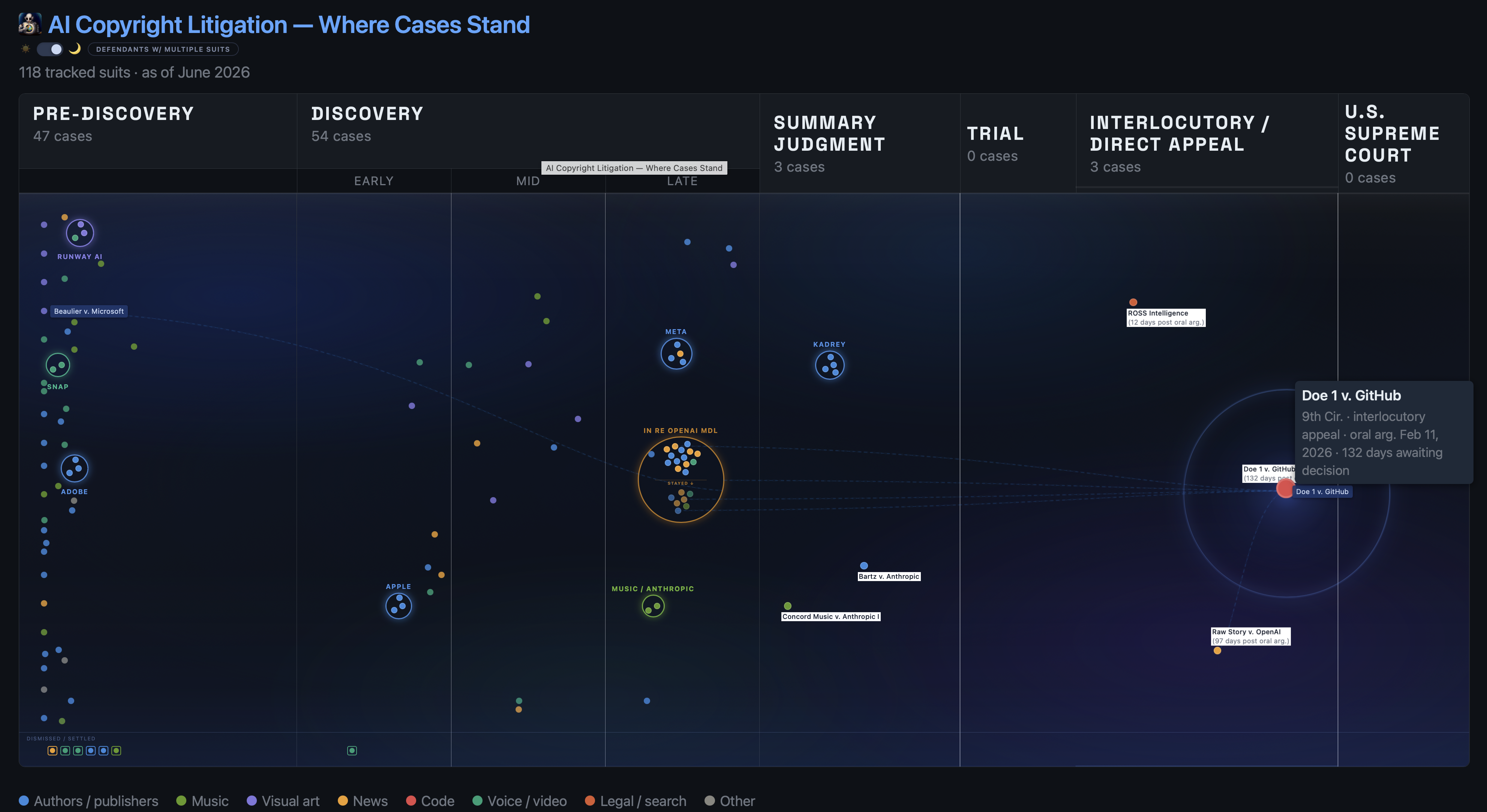
Today, we are launching the AI Status Copyright Cases Tracker.
It depicts all 118 copyright lawsuits against AI companies in the United States by the stage of litigation: pre-discovery, discovery, summary judgment, interlocutory and direct appeals, and Supreme Court.
It also depicts how the same AI companies are commonly facing multiple lawsuits filed by different plaintiffs — a phenomenon known as parallel litigation. Parallel litigation has occurred in a variety of areas of law.
In the copyright context, the RIAA lawsuits against music file-sharers and Strike 3 Holdings against John Doe defendants who illegally filed shared their videos provide two examples of parallel litigation involving the same plaintiffs suing different defendants.
What’s different about the AI copyright lawsuits is that the parallel litigation involves both the same plaintiffs or plaintiffs in the same class (e.g., book authors, YouTube creators, visual artists, newspapers, publishers, musicians, music publishers) and some of the the same defendant AI companies.
The below graphic shows the same AI companies being sued by different plaintiffs. To see the larger version, go to the Status Tracker and click “Defendants with multiple suits” at the top.

openai faces the most lawsuits at 24:
Now, let’s take a look at the parallel litigation that OpenAI faces. Most of the lawsuits against OpenAI have been transferred to the MDL litigation before Judge Stein, as shown by the circle in the middle of this graphic below. OpenAI is the only AI company in MDL, which reduces the possibility of inconsistent judgments on the key question of fair use. Judge Stein will decide that issue on summary judgment (to the extent there are no genuine issues of material fact).

meta has the second most lawsuits at 14:
Meta faces lawsuits in pre-discovery, discovery, and one consolidated case decided on partial summary judgment, Kadrey v. Meta. But, as shown below, the majority of lawsuits Meta faces is in either discovery or even pre-discovery, with the recent filings by Elsevier and book authors Hobbs.

anthropic faces 10 lawsuits and counting:
And then there’s Anthropic. It settled the Bartz v. Anthopric suit, subject to the court’s final approval. Yet, as shown below, it still faces many other lawsuits filed by Concord Music and BMG, plus a rash of book author/publisher lawsuits: Carreyrou/Cambronne, Chicken Soup for the Soul, Cognella, Cruz, and Kwon. Even if Judge Martinez-Olguin approves the Bartz settlement, other district judges will be deciding (at least the motions for summary judgment) the other cases.

Parallel Litigation Produces a Quagmire
Especially the Bartz class action settlement shows how the parallel litigation makes it difficult for any company to resolve the claims against it. It’s a quagmire.
More plaintiffs can file lawsuits and the pending lawsuits in pre-discovery or discovery can take many years to resolve — even if by settlement. At some point, the Supreme Court will likely review some of the important legal questions raised by these cases, such as fair use in AI training. But that, too, may be at least several years away, if not more.
For now, the copyright litigation trudges along.
