One of the most fascinating developments in Silicon Valley is the extent to which AI companies are publicly boasting that they used AI agents to generate “100 percent” of the source code for a computer program.
In their view, the boast is better if humans did practically nothing. And AI did it all!
I’ve written about this tech industry phenomenon in my latest essay, “Vibe Coding Authorship,” forthcoming soon in the UCLA Law Review Discourse.
The problem with such boasts of “100 percent vibe-coded” programs is that such programs might lose their copyright — or, rather, might not even qualify for copyright.
Indeed, the more one relies on AI to write the computer programs, the scope of copyright correspondingly shrinks —- to zero, meaning no copyright, as shown below in the Figure.

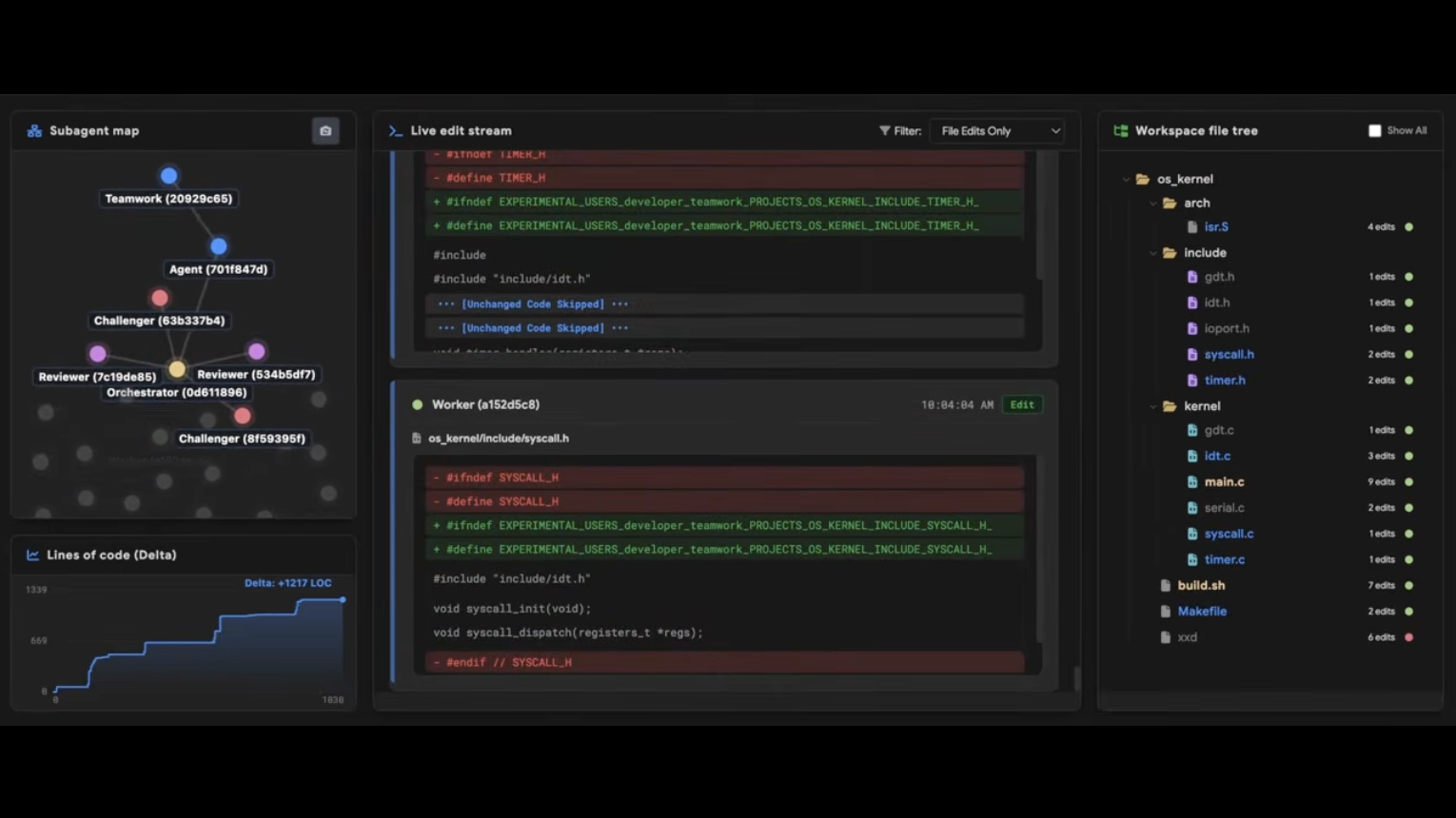
Google has upped the ante. Google boasts of using Gemini to write an entire operating system using just “in a single prompt.”
From Google’s announcement: “We’ll save the suspense. We went straight to building an operating system from scratch. It worked. It took 93 subagents, 15,314 model calls, and over 339M input tokens (with cache reads, output, and thinking, that number goes to over 2.6B tokens). We could play Doom on it. But the code wasn’t particularly the exciting part.
“It was done using Gemini 3.5 Flash from a single prompt.” (emphasis by Google!)
Google admits the OS is not perfect, but also admits the level of human input was minimal: “Of course this OS is not perfect, as it was generated off a single prompt and had no additional guidance or corrections from a human. The code is not immediately at the same high quality as would be expected from veteran developers. It doesn’t have support for floating math, hardware acceleration, complex multi-threading, sandboxing, JIT compilation, complex audio/video decoding, and a number of other components that would take this from a barebones functional OS to what people would consider to be in the ballpark of modern OSs.
“But from just a single high-level prompt and for less than $1000?“
This OS generated by “just a single high-level prompt” would almost certainly be ineligible for copyright under the U.S. Copyright’s Office’s bar against any output generated by “prompts alone.” See Report at pp. 18, 41. Here we have not even “prompts alone” to generate the program, but instead “just a single high-level prompt.” That’s it. One and done.
And Google’s OS might also fail my recommended test, applying existing court precedents, focusing on whether the human has made an original selection and arrangement of elements in the program, such as its architecture or audiovisual elements. Google might be able to argue that the “high-level prompt” did contain a minimal level of creative choices in the selection and arrangement of elements.
But we’d have to inspect Google’s “single high-level prompt.” Perhaps it had numerous details about the high-level architecture embodied in the OS. Perhaps not.
Google’s boast about this operating system clearly seems to be the direction where computer programming is rapidly heading. It’s quite possible copyright becomes extinct for computer programs increasingly written by AI.
Related Stories
