Earlier, in March 2026, Stanford University filed its Answer to the Second Amended Complaint filed by EVOX Productions. EVOX is the producer of car photographs alleged to be used by Stanford researchers without licenses as a part of its ImageNet dataset.
Stanford’s defenses are no surprise. The ImageNet dataset of images scraped from the Internet and paired with text descriptors was intended only for academic AI research:


Stanford raises the fair use defense, a provision that expressly recognizes “research” and “scholarship” as legitimate fair use purposes:

What Is the ImageNet Dataset?
Stanford AI researchers created the ImageNet dataset, which consists of nearly 14 million images scraped from online.
Stanford University Professor Li Fei-Fei, who is not named in the lawsuit, is widely credited for advancing AI deep learning by overseeing the (laborious) compilation of this important ImageNet dataset that was used by AI researchers in computer vision in an annual ImageNet competition.
In 2025, the United Kingdom awarded Fei-Fei the Queen Elizabeth Prize for Engineering. Stanford described Fei-Fei’s profound impact on AI research: “Li is well-known for ImageNet, the large-scale visual database and benchmark she created with students and collaborators in the late 2000s. At a time when progress in computer vision had stalled, ImageNet provided millions of carefully labeled images in a rich, hierarchical taxonomy – offering both a rigorous testbed and a shared foundation for researchers. Its annual challenge galvanized the field, enabling breakthroughs in deep learning that rapidly improved AI’s ability to recognize objects, interpret scenes, and understand visual context. The results reshaped AI research and industry alike, catalyzing advances in autonomous systems, medical imaging, accessibility tools, and countless everyday applications.”
The AlexNet paper by Alex Krizhevsky, Ilya Sutskever, and Geoffrey Hinton, submitted to this competition, is also widely considered one of the most important research papers in the history of AI research. It is one of the most cited AI research papers ever — cited more than 155,000 times. And, yes, that’s the same Hinton who later was awarded the Nobel Prize.
Both the ImageNet dataset and the AlexNet paper were instrumental in showing how increasing — or scaling — the size of datasets can greatly improve the capabilities of AI models.
But the ImageNet dataset was not compiled or posted online with copyright licenses — which is now the basis for EVOX Productions’ lawsuit. Of course, if it’s fair use, no licenses are needed.
Some people may wonder how this case survived two motions to dismiss already. It could be that fair use, a fact-dependent inquiry, is seldom enough to warrant a motion to dismiss. But sometimes courts do dismiss when fair use is apparent from the allegations. See, e.g., Yang v. MIC Network Inc., 2022 WL 906513 (2d Cir. 2022) (article’s use of portion of photograph in screenshot for commentary was fair use); Righthaven LLC v. Realty One Group, Inc., 2010 WL 4115413 (D. Nev. Oct. 10, 2010) (blog post copied 8 sentences of 30 sentence news article was fair use).
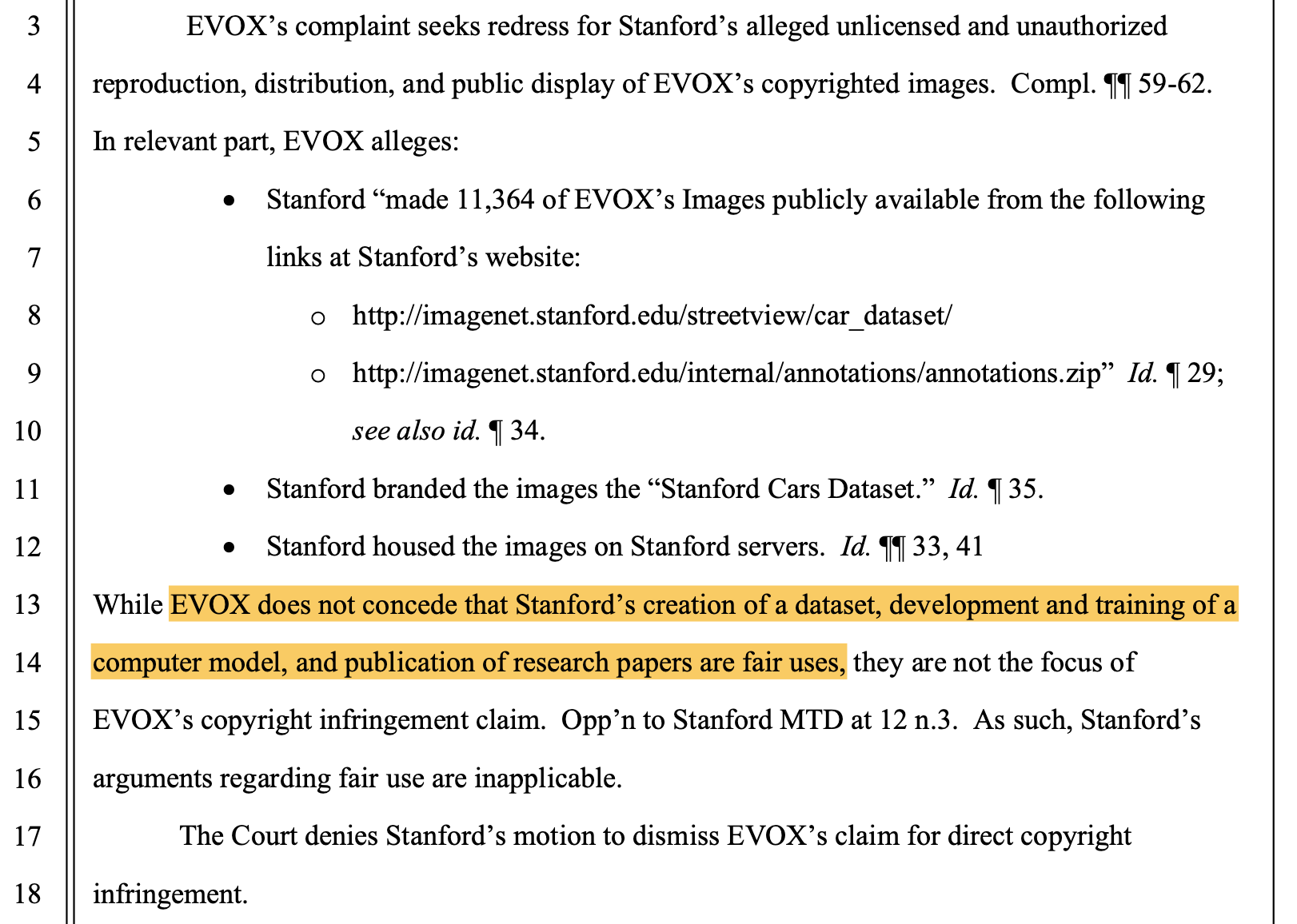
EVOX Productions does not concede even “creation of a dataset, development and training of a computer model, and public research papers are fair uses”
Judge Wise’s opinion partly denied and partly granted Stanford’s motion to dismiss the original complaint.
There’s an intriguing passage in Judge Wise’s opinion. (I’ll have more to say on the decision on contributory infringement in a follow-up post.)
EVOX Productions does not even concede that the “creation of a dataset, development and training of a computer model, and public research papers are fair uses,” although “they are not the focus of EVOX’s copyright infringement claim.”
Therefore, Judge Wise allowed the direct infringement claim against Stanford. Stanford did not seek to dismiss it again in its later motion to dismiss (focusing instead on one theory of contributory infringement). This issue highlighted above in bold strikes me as too hard to disentangle from EVOX Productions’ theory of liability. After all, the lawsuit is about the unlicensed use of photographs in ImageNet and its offering to the public.
I haven’t pored over all the briefing and pleadings yet. With that caveat, let me suggest there should be no dispute that ImageNet was made to facilitate precisely this: “creation of a dataset, development and training of a computer model, and public research papers.” The ImageNet dataset was crucial to the annual competition in computer vision — and it led to considerable research and incredible advances in AI, some of which I mention above.
When the court says “Stanford’s arguments regarding fair use are inapplicable,” presumably that means on a motion to dismiss. Granted, fair use may be seldom decided on a motion to dismiss, given how it depends on facts. But some cases have done so.
For that reason I think it would have been helpful if the court did analyze Stanford’s fair use defense, even if only to explain a bit more why fair use could not be decided on a motion to dismiss. For example, the court could have explained which allegations of EVOX Productions were sufficient to potentially fall outside of fair use — i.e., “the focus of EVOX’s copyright infringement claim” that made “inapplicable” the fair use defense based on Stanford’s “creation of a dataset, development and training of a computer model, and public research papers.“
I think it’s hard to see any other purpose for ImageNet than that. If so, EVOX Productions’ theory of liability arguably shouldn’t preclude the court’s consideration of fair use based on ImageNet’s purpose. Of course, the court would still need to run through all 4 fair use factors, including the amount and substantiality of the portion used (by Stanford) under Factor 3. Perhaps these factors can’t be decided on the allegations of the complaint in the way other cases have sometimes done. But they do seem relevant whatever EVOX Productions’ Complaint’s focus is.
And AI research was the raison d’etre for ImageNet. EVOX Productions might not concede such research purpose was a fair use, even when used for scholarship, but the text of Section 107, which expressly mentions both research and scholarship, provides courts ample ground on which to so rule just as other courts have done, on motions to dismiss, with respect to “news reporting,” also expressly mentioned in Section 107.

This case is proceeding forward, however. The more important analysis comes at the summary judgment stage, which starts in December 2026, as noted in the schedule below.
The summary judgment briefing will be one of the most important for all of AI research in the United States.
If you want to learn more about the history of AI research and training of models, take a look at my law review article, “Fair Use and the Origin of AI Training,” published in the Houston Law Review.
Scheduling Order in EVOX Productions v. The Leland Stanford Jr. University:

DOWNLOAD STANFORD UNIVERSITY’S ANSWER
DOWNLOAD THE COURT’S FIRST OPINION ON THE FIRST MOTION TO DISMISS
Related Stories
