How It Started in 2022
In late 2022, a relatively unknown startup called OpenAI launched ChatGPT.
That “ChatGPT moment” changed the trajectory of technology and society. It ushered in the Age of AI.
Microsoft, too, benefited from this ChatGPT moment. Its partnership with OpenAI gave it access to OpenAI’s models that Microsoft soon deployed in its Office programs, including in CoPilot.
Meanwhile, Google was so rattled co-founder Sergei Brin came out of retirement after Google hastily called a “code red.” Google was behind in the AI arms race. Google, in fact, had shared its development of the all-important “transformer” technology that led to ChatGPT.
Brin later admitted it was a mistake to give away this transformative technology (pun intended).
Microsoft CEO Satya Nadella even said at the time: “I hope that with our innovation, they [Google] will definitely want to come out and show that they can dance, and I want people to know that we made them dance.“
How It’s Going in 2026
Four years later, the AI landscape looks a lot different. The hottest AI startup company is no longer OpenAI. It’s Anthropic, a company co-founded by seven former employees of OpenAI, including Dario Amodei, its CEO.
Both OpenAI and Anthropic are reportedly considering IPOs as soon as this year.
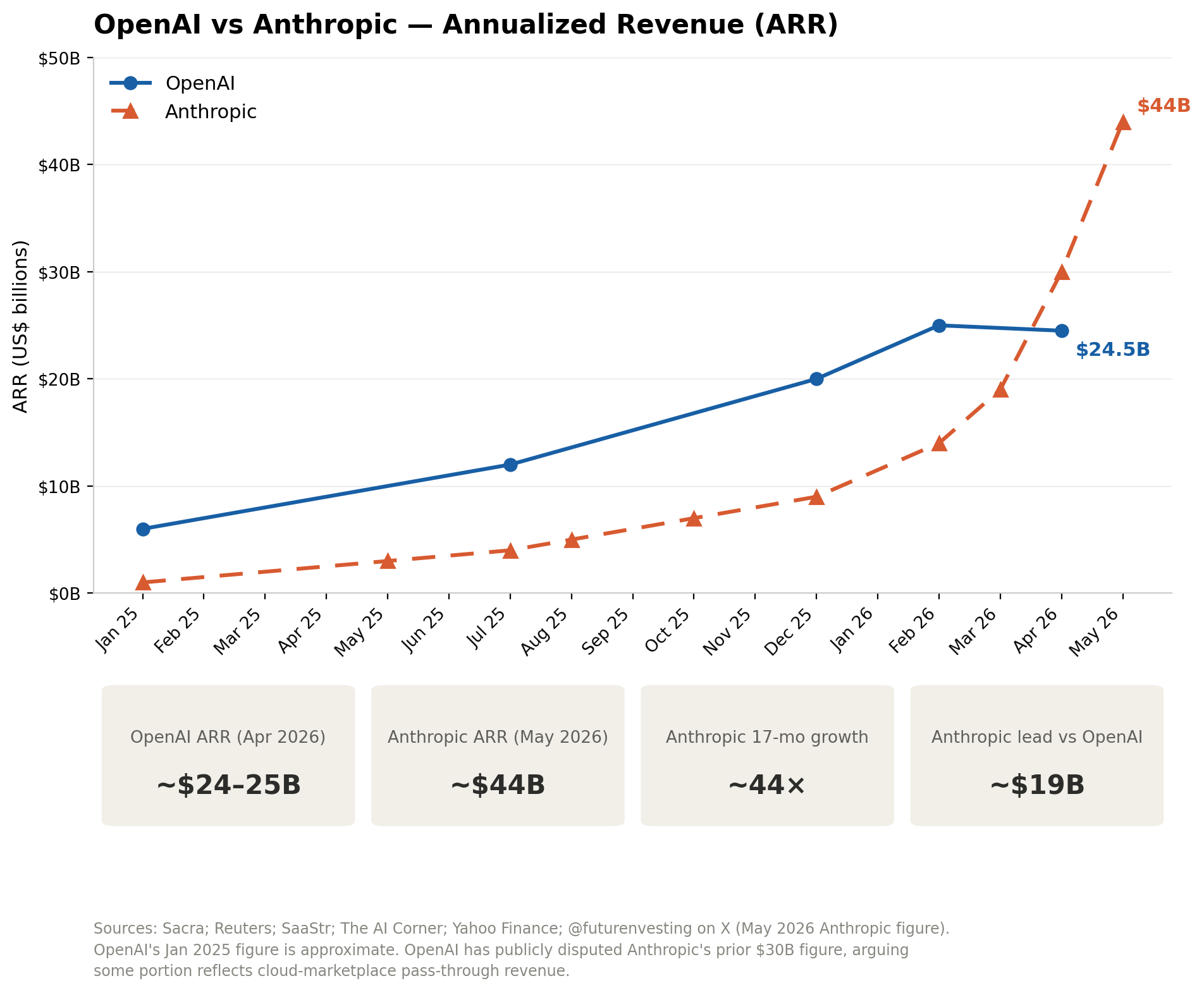
Recently, though, Anthropic overtook OpenAI, by some estimates, in annual recurring revenue (ARR). The surge in revenues for Anthropic is driven by its ever popular Claude Code program. Claude Code basically enables everyone to “vibe code” computer programs and apps without having to write a single line of source code. I even can do it!

Plus, Google has rebounded quickly with the development of its AI programs, including Gemini. If Microsoft wanted Google to dance, it did.
On top of these numbers, Google upped its investment in Anthropic!
How did OpenAI fumble its lead?
A decade from now, business school courses might be studying this formative period of the AI industry, and how OpenAI fumbled its lead in AI.
I’ve already analyzed some of the possible reasons, but let me try to compile a running list here.
1. The Kitchen sink approach: Openai tried to do too much
Successful startups often do one thing incredibly well—and one thing alone. Back in the day, Google solved Internet search. And, to this day, advertising on its search engine is Google’s largest source of revenue.
By contrast, OpenAI had become, by the company’s own admission, unfocused. The failed Sora video image generator (and deal with Disney that was nixed) is the biggest example. But let’s not forget (1) the much ballyhooed project with Johnny Ive for an AI device, (2) the voice project that sounded like Scarlet Johansson, and (3) the “GPT store” where people could develop a GPT and apparently try to sell it like apps on Apple’s app store.
As I wrote back in January 2026: “In terms of its business model, OpenAI appears to be massively spending on a wide array of projects, from ChatGPT to Sora, from apps geared to individual to, more recently, apps for enterprise. A kitchen sink approach. By contrast, Anthropic has focused more narrowly on Claude Code and enterprise applications, such as for writing computer code.”
The “kitchen sink” approach has led to massive spending by OpenAI, which, the Wall Street Journal just reported, CFO Sarah Friar has tried to rein in ahead of its expected IPO.
2. OpenAI as the first mover in AI attracted the most scrutiny and lawsuits
Another factor that has produced headwinds for OpenAI is that it has attracted the greatest public scrutiny—and the greatest number of copyright lawsuits (for alleged infringement to train their AI models).
Being first is sometimes a disadvantage, what’s called a first-mover disadvantage.
I’ve recounted these headwinds OpenAI faces in a prior post:
Summarized here by AI Mode (irony intended):

3. Sam altman as ceo is questioned like no other
Related to the intense scrutiny of OpenAI as the first mover, another factor that might be at play: Sam Altman has been questioned as CEO like no other CEO of any AI startup.
The Wall Street Journal just discussed Altman’s role as CEO—even asking, as one possibility: “will he become like Travis Kalanick, a talented entrepreneur who flamed out in the midst of scandals before Uber Technologies could go public and reward investors who had worried that he wasn’t the guy to land the plane despite everything already accomplished?”
It is a legitimate question to ask, especially given the failed ouster of Altman back in 2023:
Altman could still deliver on OpenAI’s success. He’s proven to be adept at skirting attempts to dethrone him, including the early overture by Elon Musk, now a part of he ongoing trial on OpenAI’s formation in Musk v. Altman.
Yet, even if Altman remains as CEO through the expected IPO, that doesn’t guarantee OpenAI’s success. That will just mean Altman will have to prove himself for the next phase of OpenAI.
