Mark your calendars for June 11, 2026. The Third Circuit will hear oral argument in Thomson Reuters v. ROSS Intelligence.
It’s the first appeal of a decision related to the question whether the use of copyrighted works (here, Westlaw headnotes for judicial opinions) to train an AI model is a fair use.
Judge Bibas reversed his initial 2023 decision that it may be and ultimately held that it was not a fair use in his 2025 decision. That decision led to this interlocutory appeal, which also included the question whether Westlaw headnotes satisfy originality. Judge Bibas acknowledged the two issues are both “hard under existing precedent,” leaving substantial ground for difference of opinion.
Recent fair use decision by Third Circuit
Fortuitiously for ROSS Intelligence, the Third Circuit recently held that a AI-native startup company UpCodes’ platform or service providing the public with access to building codes that have been adopted as the law by different jurisdictions is likely a fair use.
The copyrighted works in UpCodes involved building codes and commentary drafted by American Society for Testing & Materials, as summarized by the Third Circuit: “In April 2024, UpCodes began publishing copyrighted ASTM standards on its website without securing a license to do so. UpCodes’ online library includes ten copyrighted ASTM standards related to steel and aluminum used in construction (the ‘Works’). Each of the Works contains ‘mandatory’ text that outlines technical requirements and ‘non-mandatory’ or supplemental text, such as explanatory notes, supplemental materials, appendices, and annexes. UpCodes publishes the entirety of the Works on its website, including the mandatory and non-mandatory portions.” (emphasis added).
The Third Circuit agreed with the district court’s denial of preliminary injunction given the likelihood that UpCodes would prevail on its fair use defense.
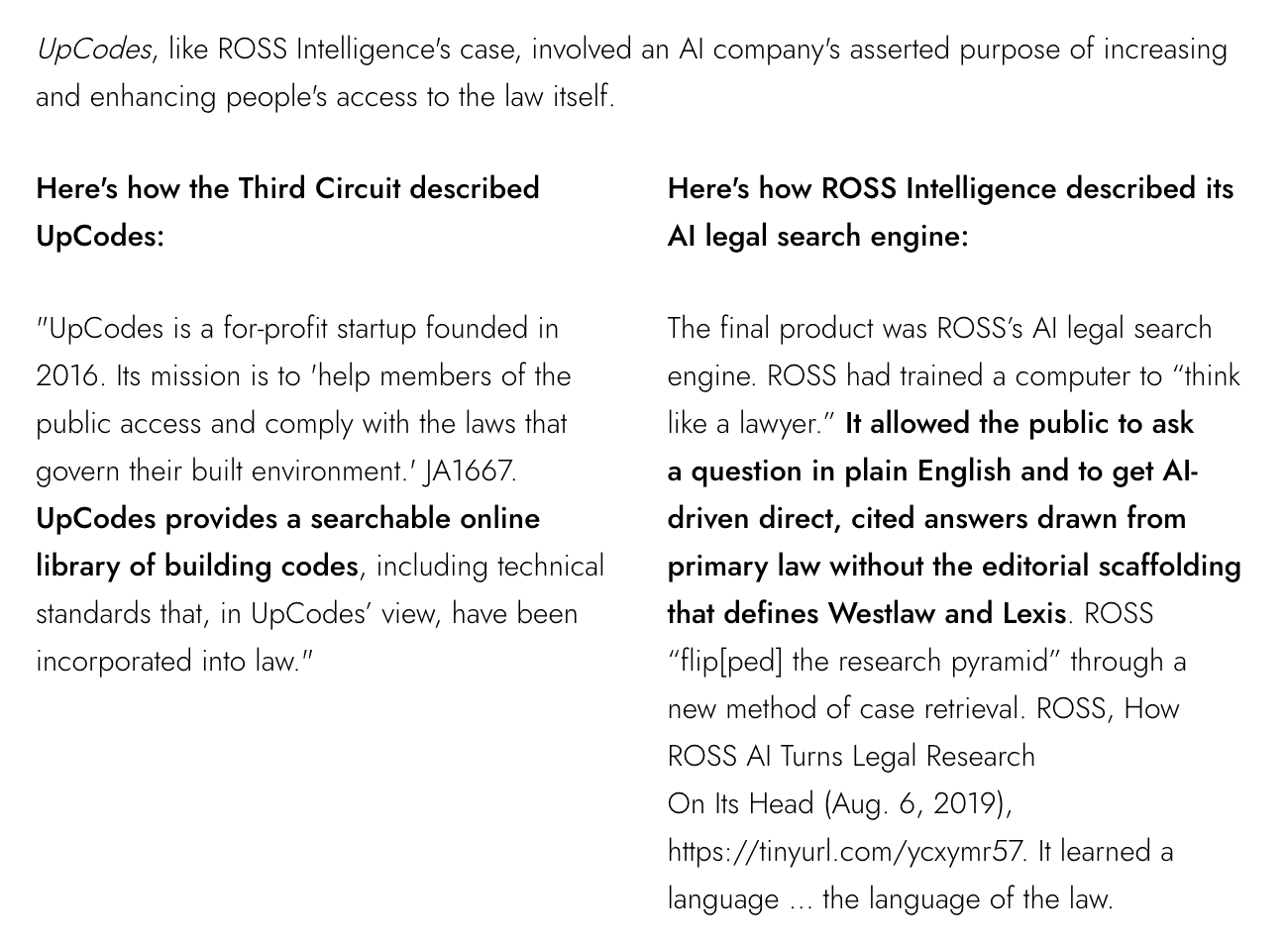
UpCodes, like ROSS Intelligence’s case, involved an AI company’s asserted purpose of increasing and enhancing people’s access to the law itself.
Here’s how the Third Circuit described UpCodes:
“UpCodes is a for-profit startup founded in 2016. Its mission is to ‘help members of the public access and comply with the laws that govern their built environment.’ JA1667. UpCodes provides a searchable online library of building codes, including technical standards that, in UpCodes’ view, have been incorporated into law.”
Here’s how ROSS Intelligence described its AI legal search engine:
The final product was ROSS’s AI legal search engine. ROSS had trained a computer to “think like a lawyer.” It allowed the public to ask
a question in plain English and to get AI-driven direct, cited answers drawn from primary law without the editorial scaffolding that defines Westlaw and Lexis. ROSS “flip[ped] the research pyramid” through a
new method of case retrieval. ROSS, How ROSS AI Turns Legal Research
On Its Head (Aug. 6, 2019), https://tinyurl.com/ycxymr57. It learned a
language … the language of the law.
ROSS Intelligence could not have asked for a better fair use precedent handed down before its oral argument.


Briefs
You can download all the briefs here:
Disclosure: I was part of a group of law professors who filed an amici brief in support of ROSS Intelligence.
