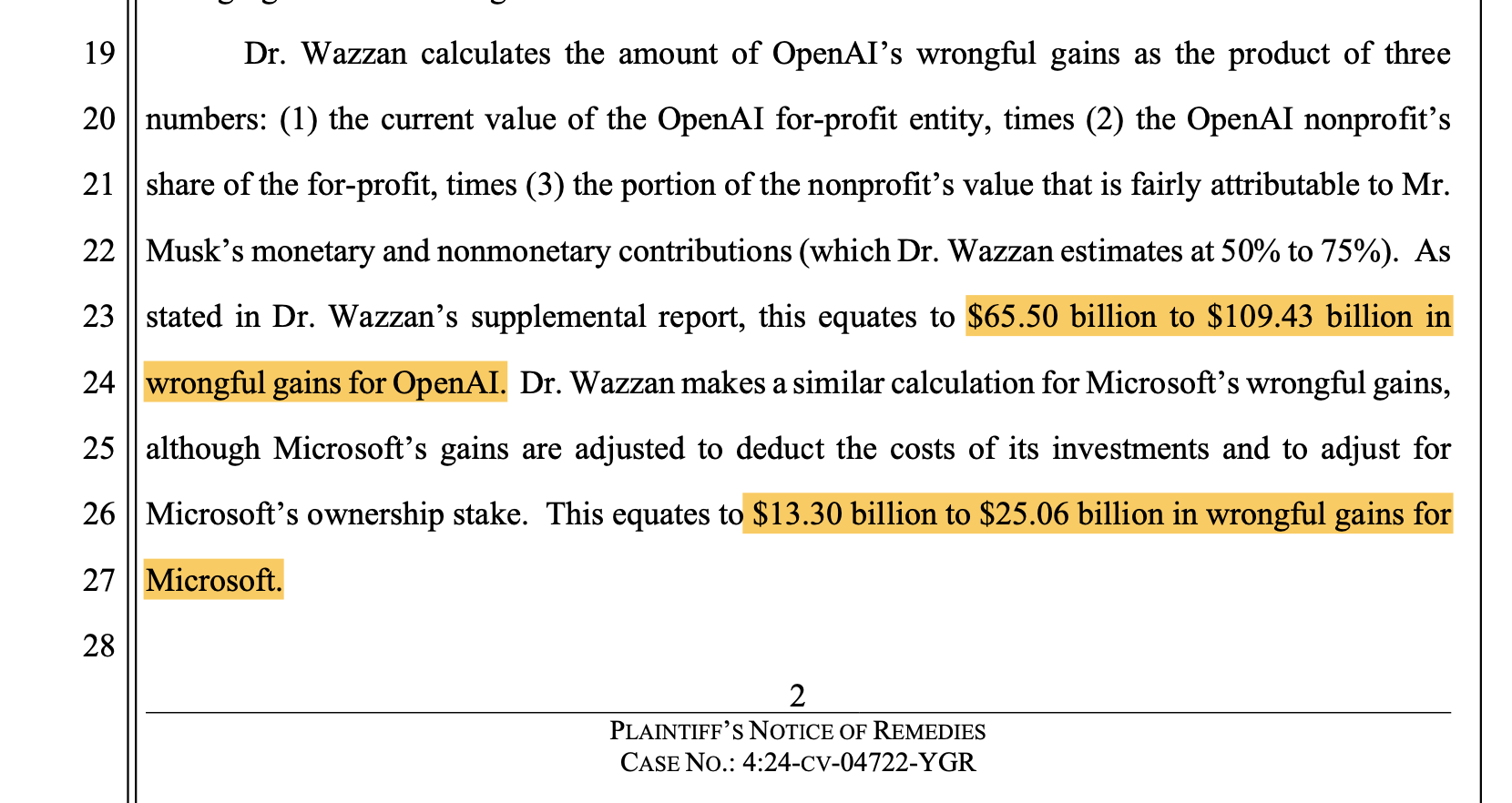
- In Musk v. Altman, plaintiff Elon Musk seeks (1) $65.50B to $109.43B from OpenAI and (2) $13.30B to $25.06B from Microsoft.
- Musk also will seek punitive damages if he prevails on the intentional tort claims.
- Plus, Musk seeks an injunction, potentially stopping OpenAI from its for-profit conversion.
- What started out as a lawsuit that few experts viewed as promising just turned into a serious matter.
Elon Musk filed his notice of remedies sought from OpenAI and Microsoft in the upcoming April 2026 trial. Should he prevail in Elon Musk v. Sam Altman for alleged fraud in creating OpenAI in part with Musk’s money, Musk seeks an award of damages in the tens of billions.
Based on Elon Musk’s economist expert Dr. C. Paul Wazzan, Musk is asking for disgorgement of (1) $65.50B to $109.43B from OpenAI and (2) $13.30B to $25.06B from Microsoft, allegedly the fruits of Musk’s investments in OpenAI.
Musk also will seek punitive damages if he prevails on the intentional tort claims. To put these numbers into perspective, OpenAI raised somewhere in the ballpark of $40 billion in March 2025. By some estimates, OpenAI has only “$17.5 billion in cash and securities” in reserve. A scenario of a damages award of more than $100 billion against OpenAI, not even counting any punitive damages, would be unsettling for OpenAI to say the least.

What about damages from Sam Altman and Greg Brockman?
Curiously, the notice does not state any specific amount sought from Sam Altman and Greg Brockman, who are also sued in the Complaint. Putting aside any indemnification by OpenAI, presumably Altman and Brockman might be found personally liable if the allegations in the Complaint are proven because it alleges intentional torts, including fraud.
Can an injunction stop OpenAI from for-profit conversion?
Musk also seek injunctive relief. Judge Gonzalez Rogers has already rejected Musk’s request for a preliminary injunction to stop OpenAI’s conversion to a for-profit company as “extraordinary and rarely granted.” However, the Judge appeared to leave open at least a slim possibility of such relief after a trial with a full evidentiary record (assuming liability is found): “The relief requested is extraordinary and rarely granted as it seeks the ultimate relief of the case on an expedited basis, with a cursory record, and without the benefit of a trial.”
And, in recently denying OpenAI’s motion for summary judgment and ordering a trial, the Judge has allowed Musk’s breach of charitable trust claim. In denying the preliminary injunction, the Judge appeared to assume that injunctive relief is available but ruled that “[b]ecause the threshold question of whether a charitable trust was created remains a toss-up, Musk has not demonstrated likelihood of success on the merits sufficient to obtain an injunction.”
Presumably, if Musk prevails at trial on this claim, the Judge will have to consider whether to grant injunctive relief.
DOWNLOAD MUSK’S NOTICE OF REMEDIES
Related Stories