Governor Gavin Newsom was busy yesterday, signing not one, not two, not three … but five deepfake bills into law in California. We’ve extracted the relevant descriptions provided by Newsom’s press releases below.
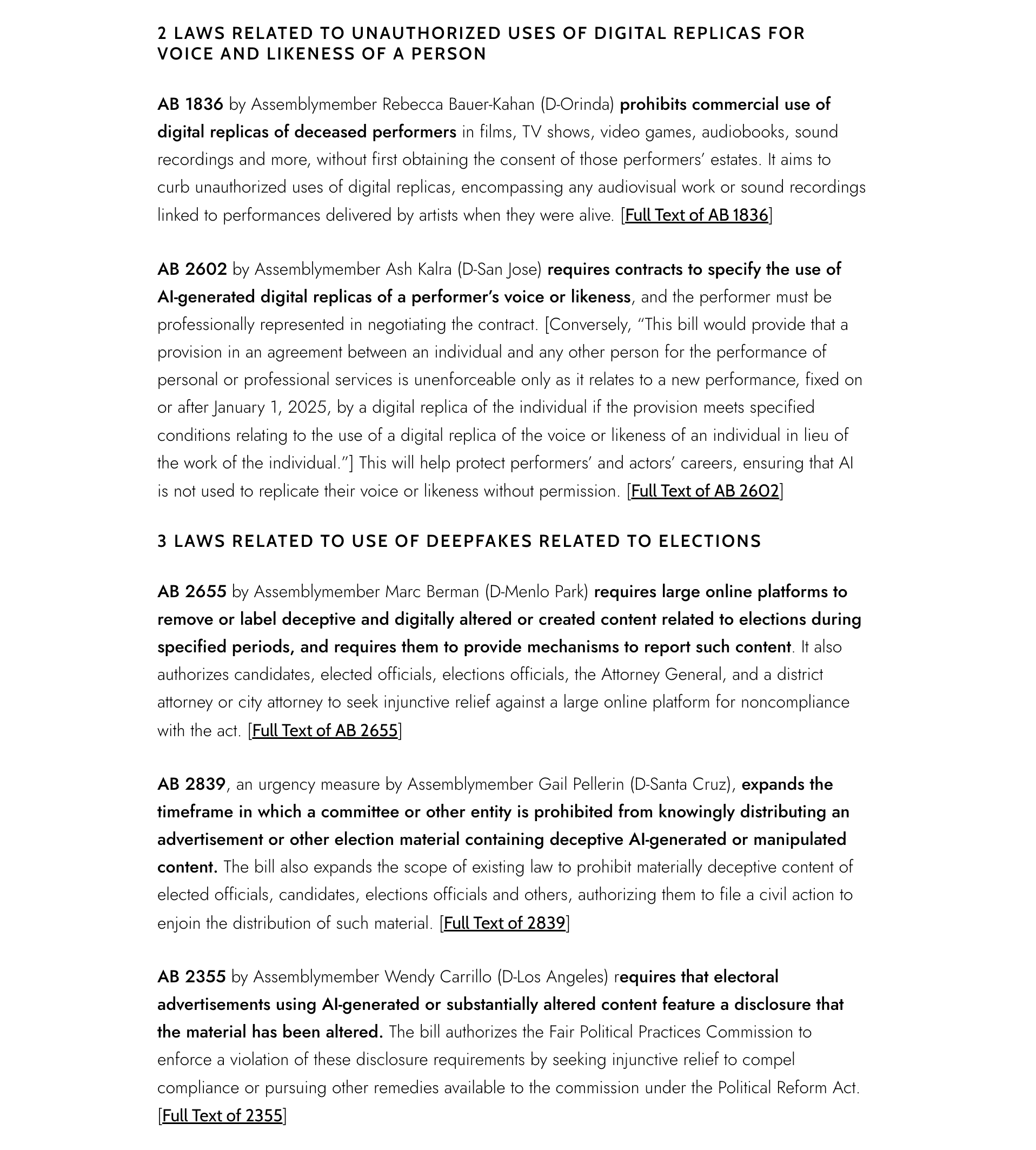
2 Laws related to unauthorized uses of digital replicas for voice and likeness of a person
AB 1836 (Use of likeness: digital replica) by Assemblymember Rebecca Bauer-Kahan (D-Orinda) prohibits commercial use of digital replicas of deceased performers in films, TV shows, video games, audiobooks, sound recordings and more, without first obtaining the consent of those performers’ estates. It aims to curb unauthorized uses of digital replicas, encompassing any audiovisual work or sound recordings linked to performances delivered by artists when they were alive. [Full Text of AB 1836] [Cal Matters summary]

AB 2602 by Assemblymember Ash Kalra (D-San Jose) requires contracts to specify the use of AI-generated digital replicas of a performer’s voice or likeness, and the performer must be professionally represented in negotiating the contract. [Conversely, “This bill would provide that a provision in an agreement between an individual and any other person for the performance of personal or professional services is unenforceable only as it relates to a new performance, fixed on or after January 1, 2025, by a digital replica of the individual if the provision meets specified conditions relating to the use of a digital replica of the voice or likeness of an individual in lieu of the work of the individual.”] This will help protect performers’ and actors’ careers, ensuring that AI is not used to replicate their voice or likeness without permission. [Full Text of AB 2602]

3 Laws related to use of deepfakes related to elections
AB 2655 (Defending Democracy from Deepfake Deception Act of 2024) by Assemblymember Marc Berman (D-Menlo Park) requires large online platforms to remove or label deceptive and digitally altered or created content related to elections during specified periods, and requires them to provide mechanisms to report such content. It also authorizes candidates, elected officials, elections officials, the Attorney General, and a district attorney or city attorney to seek injunctive relief against a large online platform for noncompliance with the act. [Full Text of AB 2655] [Cal Matters summary] [goes into effect January 1, 2024]
From the bill’s summary:
This bill, to be known as the Defending Democracy from Deepfake Deception Act of 2024, would require a large online platform, as defined, to block the posting of materially deceptive content related to elections in California, during specified periods before and after an election. The bill would require a large online platform to label certain additional content inauthentic, fake, or false during specified periods before and after an election in California.
The bill would require a large online platform to develop procedures for California residents to report content that has not been blocked or labeled in compliance with the act. The bill would also authorize candidates for elected office, elected officials, elections officials, the Attorney General, and a district attorney or city attorney to seek injunctive relief against a large online platform for noncompliance with the act, as specified, and would assign precedence to such actions when they are filed in court.
From the statute, the exceptions:
This chapter does not apply to any of the following:
(a)A regularly published online newspaper, magazine, or other periodical of general circulation that routinely carries news and commentary of general interest, and that publishes any materially deceptive content that an online platform is required to block or label based on this chapter, if the publication contains a clear disclosure that the materially deceptive content does not accurately represent any actual event, occurrence, appearance, speech, or expressive conduct.
(b)(1)A broadcasting station that broadcasts any materially deceptive content prohibited by this chapter as part of a bona fide newscast, news interview, news documentary, commentary of general interest, or on-the-spot coverage of bona fide news events, if the broadcast clearly acknowledges through content or a disclosure, in a manner that can be easily heard or read by the average listener or viewer, that the materially deceptive content does not accurately represent any actual event, occurrence, appearance, speech, or expressive conduct.
(2)A broadcasting station when it is paid to broadcast materially deceptive content and either of the following circumstances exist:
(A)The broadcasting station can show that it has prohibition and disclaimer requirements that are consistent with the requirements in this chapter and that it has provided those prohibition and disclaimer requirements to each person or entity that purchased the advertisement.
(B)Federal law requires the broadcasting station to air advertisements from legally qualified candidates or prohibits the broadcasting station from censoring or altering the message.
(c)Materially deceptive content that constitutes satire or parody.
AB 2839 (Elections: deceptive media in advertisements), an urgency measure by Assemblymember Gail Pellerin (D-Santa Cruz), expands the timeframe in which a committee or other entity is prohibited from knowingly distributing an advertisement or other election material containing deceptive AI-generated or manipulated content. The bill also expands the scope of existing law to prohibit materially deceptive content of elected officials, candidates, elections officials and others, authorizing them to file a civil action to enjoin the distribution of such material. [Full Text of 2839] [Cal Matters summary] [goes into effect immediately]
AB 2355 (Political Reform Act of 1974: political advertisements: artificial intelligence.) by Assemblymember Wendy Carrillo (D-Los Angeles) requires that electoral advertisements using AI-generated or substantially altered content feature a disclosure that the material has been altered. The bill authorizes the Fair Political Practices Commission to enforce a violation of these disclosure requirements by seeking injunctive relief to compel compliance or pursuing other remedies available to the commission under the Political Reform Act. [Full Text of 2355] [Cal Matters summary]
The laws add to California’s existing deepfake laws AB 730 (deepfake camgaign video against a candidate within 60 days of election) and AB 602 (creating cause of action for use of likeness in pornographic deepfake).
