On Dec. 11, 2024, the U.S. Copyright Office published its decision denying the copyright ability, for lack of human authorship, a work titled Suryast that Anki Sahni stylized using the RAGHAV Artificial Intelligence Painting App. The rejection of copyright follows the Office’s rejections of copyright to AI prompt-engineered visual works by Jason Allen and Kristina Kashtanova, respectively. Earlier this year, the Copyright Office issued a new Guidance on AI that sets a high bar for AI generated works to qualify the Office’s view of human authorship. (I’ve already explained why I believe the Office’s high bar of what qualifies as human authorship is wrong based on the Copyright Clause and Supreme Court precedent.)
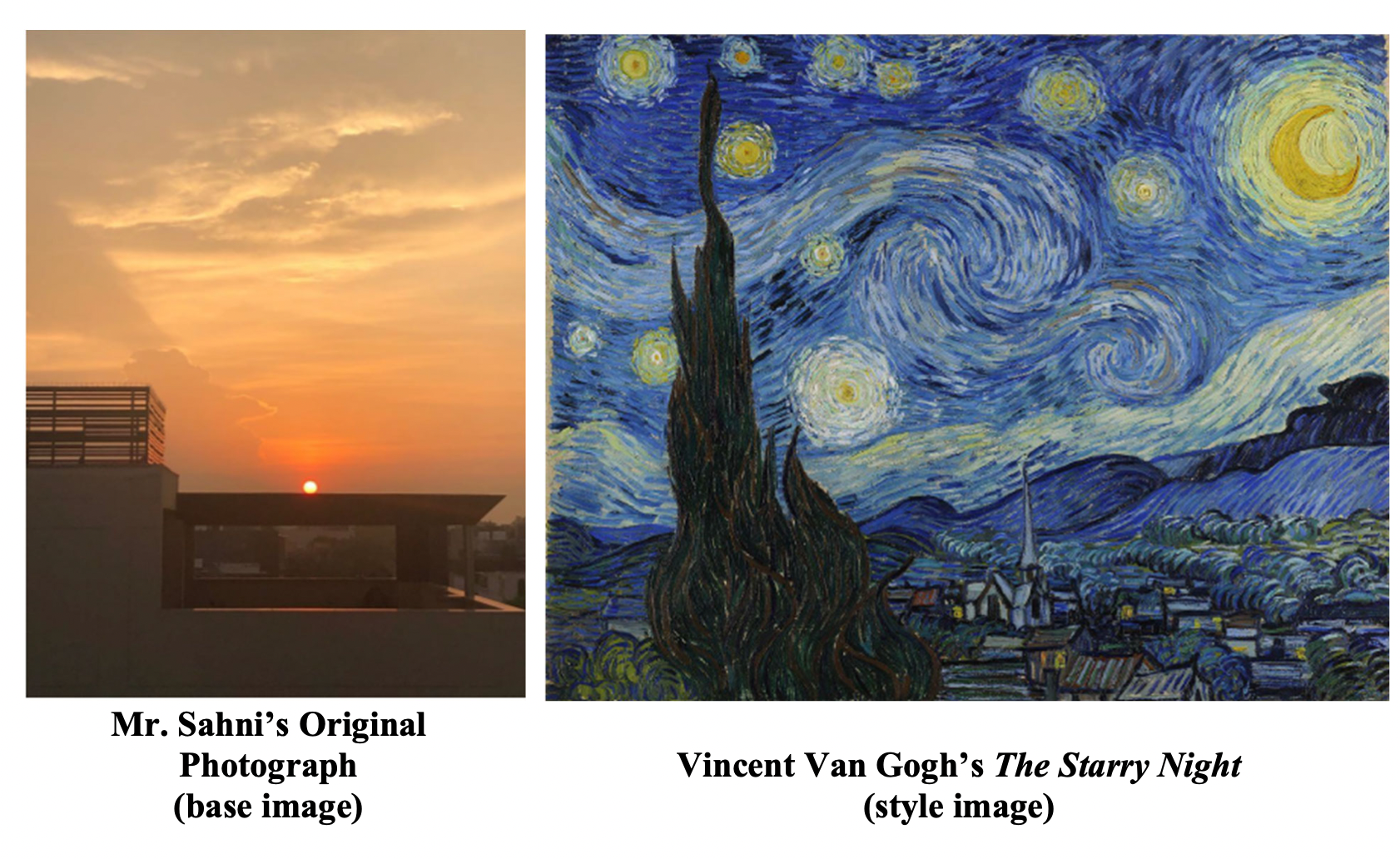
Sahni used his original photograph of a sun setting over a contemporary house in the Raghav AI painting app and stylized it in the style of Van Gogh’s The Starry Night, created in 1889.

Through the Raghav app, the final stylized work was created:

Sahni had listed both Sahni and the AI as co-authors on the registration application. Ultimately, the Copyright Office rejected the registration, ruling:
Specifically, the Board finds that the expressive elements of pictorial authorship were not provided by Mr. Sahni. As Mr. Sahni admits, he provided three inputs to RAGHAV: a base image, a style image, and a “variable value determining the amount of style transfer.” Sahni AI Description at 11. Because Mr. Sahni only provided these three inputs to RAHGAV, the RAGHAV app, not Mr. Sahni, was responsible for determining how to interpolate the base and style images in accordance with the style transfer value. The fact that the Work contains sunset, clouds, and a building are the result of using an AI tool that “generate[s] an image with the same ‘content’ as a base image, but with the ‘style” of [a] chosen picture.” Id. at 6. But Mr. Sahni did not control where those elements would be placed, whether they would appear in the output, and what colors would be applied to them—RAGHAV did.
My take: This case doesn’t involve an AI prompt-engineered work. Instead, it involves stylization through an AI app. My reaction is somewhat different from my reactions to the Copyright Office’s decisions in Allen and Kashtanova mentioned above.
Sahni’s original photograph is beautiful on its own, and perhaps if he kept more of the original elements with some new elements added in using the AI app, the combination would have satisfied the Copyright Office’s requirement of control and human authorship. The Guidance states: “This policy does not mean that technological tools cannot be part of the creative process. Authors have long used such tools to create their works or to recast, transform, or adapt their expressive authorship. For example, a visual artist who uses Adobe Photoshop to edit an image remains the author of the modified image, and a musical artist may use effects such as guitar pedals when creating a sound recording. In each case, what matters is the extent to which the human had creative control over the work’s expression and ‘‘actually formed’’ the traditional elements of authorship.”
Because Adobe’s Lightroom and Photoshop, and Capture One now include AI in their editing programs for photographs, we should expect it to be common for AI edited photographs. Presumably, these photographs are all still copyrightable, although the Copyright Office’s view might present some obstacles to aspects of photographs that involve new AI generated elements.
That scenario gets closer to what Sahni hoped to achieve here: a derivative work from his original photograph by using the stylization feature on an app. Because the Copyright Office viewed the stylization as AI controlled and generated, the Office ruled that Sahni didn’t qualify as the author of the stylized work.
One wonders, however, if photographers choose preset filters, such as in Adobe Lightroom, to change the styles of their original photographs they took, would the resulting stylized photograph no longer be entitled to copyright?
I don’t think the Copyright Office intends to go that far. But, then, what’s the difference between a creator using a preset filter to change the style of an original photograph after taking it and a creator using an AI app to do the same thing? Perhaps the difference here is that Sahni used too much stylization, changing a photograph to a Van Gogh-like artwork.
